A memorial statue was unveiled yesterday in Arnold for an engineer who pioneered a clean water system that saved thousands of lives.
Thomas Hawksley, who was born in Arnot Hill House in 1807, created a pressurised water system which improved sanitation in cities and towns across the country.
The memorial was unveiled in Arnot Hill Park by the Deputy Mayor of Gedling along with direct descendants of Mr Hawksley at the special ceremony yesterday (October 25).
Hawksley was born in Arnot Hill House, which is in the grounds of the park.
The new statue in Arnot Hill Park
The funding for the new statue was provided by Severn Trent Water, who agreed to provide £10,000 after meeting with Vernon Coaker MP and the Deputy Leader of Gedling Borough Council Cllr Michael Payne to discuss better flooding provisions in the borough.
Leader of Gedling Borough Council, Councillor John Clarke said: “Many people may not have heard of Thomas Hawksley before today but they will have benefitted from his fantastic work as a water engineer.
TRIBUTE: Pictured with the new statue is Adam Boucher, Operations Manager Severn Trent Water, left, and Richard Janes, Sculptor
“Today, we take clean water for granted but it was because of people like Thomas Hawksley that we have it. This memorial will be a fitting tribute to his excellent work and we are delighted that members of his family could be here today to see it.
“I would like to thank Severn Trent Water for providing the funding for this memorial and to everyone involved.”
Richard Janes who designed the memorial said: “The memorial takes its inspiration for the style of Victorian memorials and architecture that Hawksley would have known and designed himself. It uses engineering techniques and materials that Thomas Hawksley would have been familiar with but also uses new modern techniques to create a contemporary sculpture as a memorial to this giant of Victorian Engineering.”
Adam Boucher, Area Operations Lead for Severn Trent, said: “This is a fantastic project that we’re absolutely delighted to be a part of. Clearly, as a water company, we owe a huge debt to Thomas Hawksley which is why we’re so happy to be involved and to support the memorial.”
We have all read about gaslighting and how it affects us. But what exactly is it?
It is based on the plot of a 1938 play called “Gaslight”. In this play, a husband attempts to convince his wife that he is going insane by changing small things in their home and then telling her she is mistaken. The title is based on the fact that the husband dims the lights in their home and pretending nothing has changed. So, the wife doubts herself. His motive? To find the jewels which are hidden in the attic that belonged to a woman he has murdered. The more she doubts what she sees and hears, the easier it is for him to do what he wants, and ultimately he wants to get her sectioned so that he can search the house in peace.
Today we know gaslighting as a form of emotional abuse, such as when someone makes us question our
experiences which then really impacts our self-confidence. We lose the ability
to question our abuser (yes, they are abusers) as they challenge and change our
perceptions of their abuse. We end up scared, confused and manipulated.
The damage caused by gaslighting is huge, as we lose our
sense of self, we have no confidence in what we say, do or think, so we cannot make
decisions without referring to others, and mostly that will be the abuser.
Constantly second guessing ourselves leads to low self-esteem, we cannot trust our
view of the world and then finally we become dependent on the abuser.
Gaslighting has some key stages. The abuser is subtle and
clever, so we do not notice what is happening straight way. In fact, the abuse
is often so subtle it is way down the line before we realise just how much we
doubt ourselves. Gaslighting starts with lies and exaggeration or generalising
issues with us without facts, just statements like ‘you know I don’t like it
when you wear that dress as it’s just not you’. The next stage is repetition
and repeatedly we will hear these subjective comments about us.
At this point we may challenge the abuser and that’s when
the attacks are doubled and get worse. Out and out lies will be told to ensure
we doubt ourselves. Blame, denial and misdirection will all be used until we
are confused and doubt what happened.
PICTURED: Chales Boyer and Ingrid Bergman in Gaslight
Eventually we are worn out, riddled with doubt, fearful and
confusion turns into anxiety. We doubt our self, our perceptions and even our
reality.
So, then we are dependant and used by the abuser as they
have all our power and we are now unable to move without them. Of course, this
is just to get us to do whatever the abuser wants us to do.
To keep us there, the abuser will occasionally be nice, kind
and considerate which leads us to believe that they are not that bad. This is
purely to keep us in a state of doubt ‘She is not that bad, it must be me
overreacting’.
Gaslighting is easiest in relationships, as the constant
contact and ability to lie and deceive makes it easy to do. But It is also used
in workplaces, families and friendships.
Some key signs that we may be the victim of gaslighting are
–
We say sorry a lot and are constantly apologising as that is
easier that standing our ground. But this give our abuser an easy life as they
never have to take responsibility for their actions.
We find ourselves obsessed with our faults, whether that is
in our character, body, intelligence or personality. We start to ‘know’ we are
faulty, and we feel a lot of shame about ourselves. Our abusers have ensured
that we believe no one will want us.
Our self-esteem is so low that we believe we deserve to be
treated badly and we don’t deserve happiness or good things. As a consequence
of this, we turn down opportunities to meet friends or family and have a good
time because we believe we don’t deserve it.
We feel like a disappointment, not just to the abuser, but
to others and most importantly to ourselves. We are not good enough at
anything.
We make excuses to others about the abuser’s behaviour, by rationalising that “t’s not them it’s us”. In
fact, we won’t hear a bad word said about them, we believe they are perfect.
We know we are ‘too sensitive’ and we ‘overreact’ but it’s a
flaw and we should stop creating our own problems.
Our bodies tell us what we don’t believe and we tense up
around the abuser. The emotional abuse has created an anxiety response that is
out of our control. Our fight/flight response is activated as we prepare to be
gaslighted again.
Coming out of a gaslighting relationship is hard and we need
the support of people who care about us,. especially those who have told us
they don’t like the way we have been treated.
We need to be defiant, trust ourselves and if we did not put
the cereal in the fridge and the milk in the cupboard – don’t get up and check
it. Trusting our own version of reality is key and being angry is okay.
Let go of what you want the relationship to be and the
magical thinking that we now have. ‘If I try hard enough, she will love me
again’. We need to find our logic and look at what we are doing in this
relationship.
We also must remember who we were before and realise the
changes that we have made are completely unreasonable.
Finally, we must accept we will never ‘win’ with an abuser
as their narcissistic personality will not let you ever have the upper hand. To
fully recover we have to leave.
Emotionally abusive people are usually charming and great manipulators so we need to strong and aware of what they are capable of as we leave them behind.
A Colwick beauty therapy expert is celebrating after scooping a top regional industry award last week at a glamorous event in Birmingham.
Suzy Rose saw off stiff competition to be named Beauty Therapist of the Year at the Midlands Beauty Industry Awards last Sunday (October 20).
The young entrepreneur runs Beauty by Suzy Rose and has a salon in the village.
Suzy was one of hundreds of professionals from across the region’s beauty sector gathered on at The Holiday Inn Birmingham Airport to celebrate their success.
The awards showcased doctors, dentists, aesthetic
clinics, hair and beauty teams and spas amongst other that take care of our
appearance with innovative treatments and services.
PICTURED: Suzy Rose was named as Beauty Therapist of the Year at the Midlands Beauty Industry Awards last week
Suzy told Gedling Eye: “This is the first award I’ve been nominated for, and just to be nominated would have been a blessing. I have put in so much work and so glad its finally paying off.
“To even be nominated
was one thing, but to be crowned the Best Beauty Therapist out of the whole of
the Midlands really gives me such pride. I cant wait for my business to grow
further with a training academy in the works so I can pass on my beauty
experience and knowledge to others. This award will only be the start of great
things to come from Beauty by Suzy Rose”
Irfan Younis, CEO of the event organisers Creative Oceanic, said: “The beauty sector plays a vital role in the country’s economy and enhances the local community by employing hundreds of staff.
“The winners reflect the creativity and talent that
flows within the profession. These specialists inspire others when it comes to
the big and competitive world of beauty.
“It is important to acknowledge these specialists
for their hard work and let them know that their dedication to making people
beautiful doesn’t go unnoticed.
“We would like to congratulate all finalists and winners for their achievements and we hope that they will keep up their amazing work.”
Drinkers in Gedling borough are to be given extra time to raise a toast to Britain’s war heroes next year.
The Government has announced plans to extend pub licensing hours across England and Wales to mark the 75th anniversary of VE Day.
Under the proposals, pubs, clubs and bars in the borough which are licensed to trade until 11pm will be allowed to open until 1am on both Friday, May 8 and Saturday, May 9, 2020.
The news follows the decision to move the early May bank holiday in 2020 from Monday, May 4 to Friday, May 8 to make the 75th anniversary of VE Day a public holiday.
Pub opening hours are being extended to mark VE Day
The occasion will see celebrations and community events across the country to remember the contribution of British, Commonwealth and Allied Armed Forces personnel and all those citizens who contributed to the war effort and safeguarded the home front.
Home Secretary Priti Patel said: “VE Day is a landmark day in our history. Extending licensing hours will pave the way for commemorative events across the UK, so we can pay tribute to the courage and determination of the millions who fought for our freedom or supported the war effort at home.
“The extension of pub opening hours will be subject to a short consultation with partners including the police, licensing authorities, industry, community groups and veterans organisations.”
Past national occasions where the government has extended licensing hours have included the Royal Wedding in 2018, the Queen’s 90th birthday in 2016, the 2014 World Cup, the Queen’s Diamond Jubilee in 2012 and the Royal Wedding in 2011.
A scheme which seeks to improve the social lives of vulnerable people in Gedling borough has received a welcome cash boost from a local housing group.
The Jigsaw Homes Group – which owns Gedling Homes – has awarded the SPRIING (Social Prescribing Reducing Isolation In Gedling) project £14,180, to help ensure their survival.
The project, which is staffed by volunteers, helps
vulnerable people in the area find social groups and activities to suit their
needs.
SPRIING also provides small grants to local groups to ensure
their survival and also provide social opportunities for people in the area who
may be experiencing social isolation and loneliness.
PICTURED: Volunteers for SPRIING
The money was donated to the project through the Jigsaw
Rewards scheme, which allows Gedling Homes tenants to decide which local causes
should receive sums from the community cash pot.
He said: “We’re very proud to be a part of this fantastic
scheme that helps some of our most vulnerable residents. Loneliness and
isolation for older people can be devastating to their health and this project
has done a brilliant job of getting more people together and to address this
ongoing problem. We would like to thank our officers, Jigsaw Homes and all the
volunteers who are involved; you are improving peoples’ lives.”
Karen Sands, Head of Independent Living and Corporate Lead
for Gedling Homes, added: “The SPRIING project offers real meaningful
opportunities to older people who find themselves alone and isolated by
providing forums to make contact with other likeminded people, develop
friendship groups and reignite interests in activities, which for all of us
makes our lives richer.”
A 22-year-old man from Arnold has been locked up for 12 years after pleading guilty to the rape of a child.
Joshua Hibbett, of Oakington Close pleaded guilty to a total of 14 charges, including the rape of a child and taking, making, possession and distribution of indecent images of children.
Officers from Nottinghamshire Police were first made aware of Hibbett following a FBI investigation into a Russian file sharing website used to exchange indecent images of children.
In February 2018, the FBI obtained a federal search and seizure warrant to trace a particular user who was encouraging other users to trade indecent images of children. The user was subsequently found to reside in the United States.
During the FBI investigation, multiple emails associated with activity on the Russian file sharing website were found. The username of ‘Joshua Hibbett’ was linked with two email addresses that had corresponded with the suspect from the United States.
The FBI found the email address with the username Joshua Hibbett was linked to a person who lived in the United Kingdom.
A collaborative investigation from Lincolnshire Police and Nottinghamshire Police found Hibbett to be living in Nottingham.
PICTURED: Joshua Hibbett
On Wednesday 19 December 2018, Nottinghamshire Police attended a property in Oakington Close and interviewed Joshua Hibbett. He was arrested on suspicion of the making and distribution of indecent images of children.
During the search of the property, a number of digital storage media devices were seized including a mobile phone and a laptop. Both were subsequently found to contain evidence relating to Hibbett’s offending.
Most of the images appeared to have been downloaded from the Russian website originally investigated by the FBI. The images had been placed into a folder called “Secret” found in Hibbett’s gaming folder.
It was also found that Hibbett had created some of the images himself and shared them with the website.
He was sentenced to serve 12 years in prison at Nottingham Crown Court on Thursday 24 October 2019.
Detective Constable Andrew Taylor, from Nottinghamshire Police, said: “This has been a disturbing, shocking case and I am proud of the hard work of officers in the Paedophile Online Investigation Team based within Nottinghamshire Police as well as the FBI to bring Hibbett to justice.
“I’d also like to praise the young survivor for their bravery and courage in coming forward. Their strength throughout this case has been nothing short of incredible.”
An 18-year-old man has been arrested on suspicion of burglary in Gedling.
He is also being questioned in connection with three other
reported burglaries in Rushcliffe.
Nottinghamshire Police said they received an initial report
of burglary of a house in George Road, West Bridgford on October 9, 2019.
A further three burglaries in Melton Road and Patrick Road,
West Bridgford, and Lowdham Road, Gedling, took place between October 9 and 17
and are believed to be linked.
Detective Sergeant Charlotte Henson, of Nottinghamshire
Police, said: “Burglary is an incredibly traumatic crime for people to go
through and Nottinghamshire Police investigates all reports thoroughly.
“If you have any information about the incidents above,
please contact 101 and quote reference number 78 of 17 October 2019.
“If you have been a victim of burglary, please contact us as
soon as possible so that we can take the necessary steps to catch those
responsible.”
A new memorial will be unveiled tomorrow (October 25)
honouring the life of an Arnold engineer who saved thousands of lives by
creating clear water systems for towns and cities across the country.
The memorial statue to engineer Thomas Hawksley will be a
new feature in Arnot Hill Park and will be unveiled by the Deputy Mayor of
Gedling along with direct descendants of Mr Hawksley at the special ceremony
tomorrow.
Hawksley was born in Arnot Hill House, which is in the
grounds of the park.
The funding for the new statue was provided by Severn Trent
Water, who agreed to provide £10,000 after meeting with Vernon Coaker MP and
the Deputy Leader of Gedling Borough Council Cllr Michael Payne to discuss
better flooding provisions in the borough.
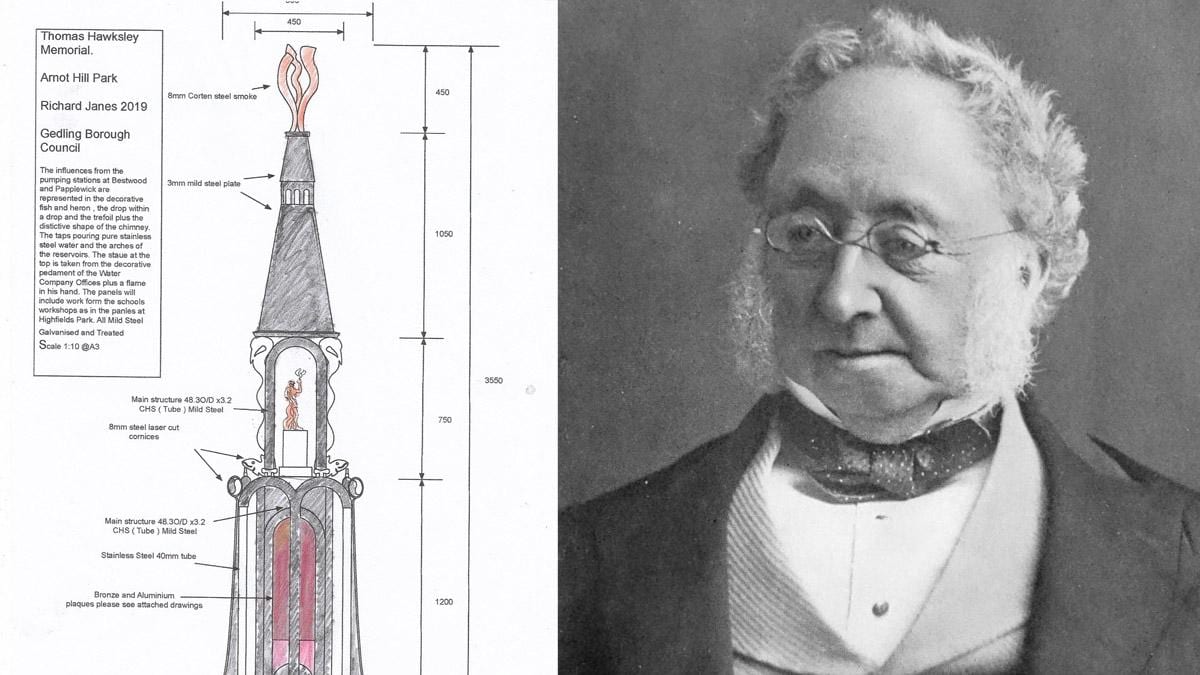
PICTURED: The design of the new memorial
The sculpture was designed and built by local artist Richard
Janes and incorporates elements of Thomas Hawksley’s work and designs using
techniques and materials that were in use at the time Hawksley was alive. The
memorial also includes elements of design from children at Arnbrook Primary
School who have worked with the artist on the memorial.
One of the council’s key priorities, set out in the Gedling
Plan, is to provide a more sustainable environment, which includes a vision to
promote and celebrate the borough’s rich heritage. The installation is part of
the council’s Gedling Heritage Brought Alive programme, which aims to increase
awareness of the famous people and places of the borough. It is also the 100
year anniversary of the opening of Arnot Hill Park Earlier this year, events
took place at the park to recognise the history and heritage of the park and
house where Hawksley was born in 1807.
Leader of Gedling Borough Council, Councillor John Clarke said: “Many people may not have heard of Thomas Hawksley before today but they will have benefitted from his fantastic work as a water engineer. Today, we take clean water for granted but it was because of people like Thomas Hawksley that we have it. This memorial will be a fitting tribute to his excellent work and we are delighted that members of his family could be here today to see it. I would like to thank Severn Trent Water for providing the funding for this memorial and to everyone involved.”
Richard Janes who designed the memorial said: “The memorial
takes its inspiration for the style of Victorian memorials and architecture
that Hawksley would have known and designed himself. It uses engineering
techniques and materials that Thomas Hawksley would have been familiar with but
also uses new modern techniques to create a contemporary sculpture as a memorial
to this giant of Victorian Engineering.”
Adam Boucher, Area Operations Lead for Severn Trent, said:
“This is a fantastic project that we’re absolutely delighted to be a part of.
Clearly, as a water company, we owe a huge debt to Thomas Hawksley which is why
we’re so happy to be involved and to support the memorial.”
Who was Thomas Hawksley?
PICTURED: Arnold-born engineer Thomas Hawksley
Hawksley, born in 1807, was the son of a yarn manufacturer
in Arnold.
Thomas was educated at Nottingham Grammar School and then
apprenticed to a firm of architects and engineer, in which he soon became a
partner. In 1830, when he was only 23, Hawksley undertook the construction for
the Trent Waterworks Company of a new pumping station adjoining Trent Bridge.
Water was obtained from the River Trent by filtration through
natural beds of sand and gravel and pumped by a cylinder steam engine through a
15 inch main to a reservoir on Park Row near the General Hospital. In 1832
Hawksley personally turned on the tap which supplied water under pressure
twenty four hours a day to the streets, courts and alleyways, so that at any
hour the housewives of Nottingham could fill their pails at the tap in the
yard.
Hawksley did not invent the principle of permanent supply
under pressure, but he was the first engineer to apply it to the very real
problem of supplying a large industrial town. According to the historian J.D.
Chambers, in the Nottingham Journal of 30 June 1949, ‘His contribution lay in
the ingenuity which he applied to overcoming the problems of plumbing . . . and
above all, in the patience he brought to bear on the still more intractable
problem of persuading plumbers to carry out his instructions’.
Nottingham was the first of more than 30 British towns (and
several abroad including Bombay) to benefit from Hawksley’s genius, which
received greater recognition from local authorities and from foreign rulers
than it has from British historians despite being the first civil engineer to
apply his talents almost exclusively to the enormous problems of urban living
in an increasingly industrial society.
Before the introduction of Hawksley’s new system, the death
rate in Nottingham was 25 percent above the national average, being only 20.5
years. His proper sanitary systems would increase the average age at death to
over 30.
MP for Gedling, Vernon Coaker has backed a campaign calling on the government to create a dedicated fund to help revitalise former mining communities.
The Coalfields Regeneration Trust said it has secured
support from cross-party MPs across the country for its proposal that a Coalfields
Fund is created.
The campaign began following the publication of the State of
the Coalfields 2019 report, which is the first piece of dedicated research on
former mining communities since 2014.
The report said these forgotten communities remain ‘scarred
by the legacy of the past’ with key findings showing that in order to raise the
employment level to that of South East England, 170,000 additional coalfield
residents would need to be in work.
Furthermore, 42 per cent of residents in coalfields live
within the 30 per cent most deprived communities in the UK, showing little
change in the last five years.
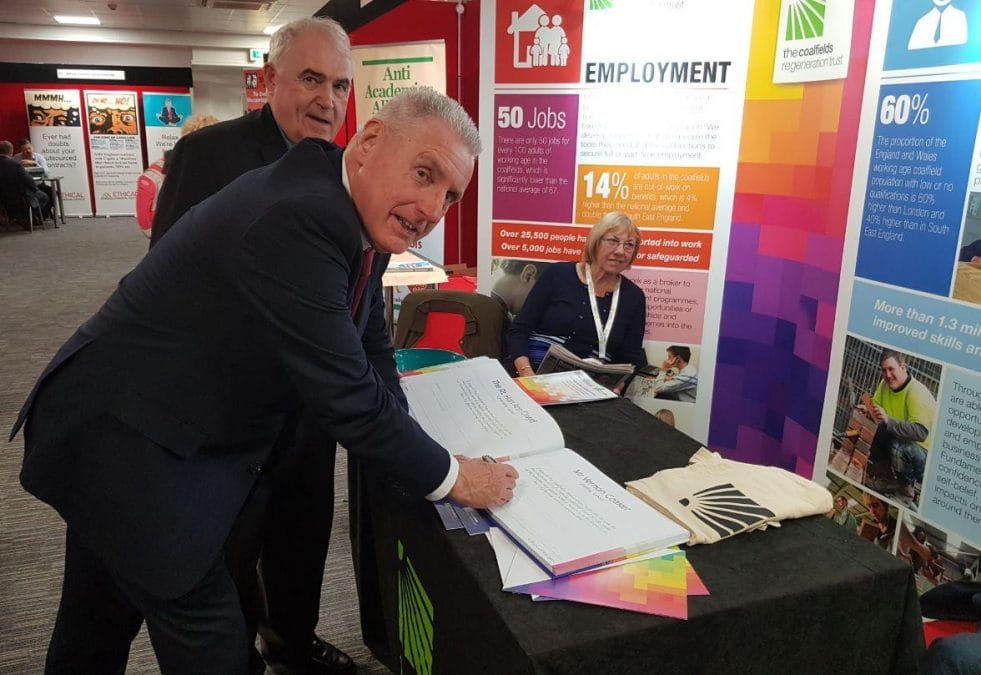
PICTURED: Gedling MP Vernon Coaker signs book of support for a Coalfields Fund
Vernon Coaker MP, who serves the Gedling constituency – a former
pit community – has confirmed his support for the Coalfields Regeneration
Trust, the only organisation dedicated to supporting the 5.7 million people
living in former mining communities throughout the UK, by signing a Book of
Support.
The Book of Support reads: “I support The Coalfields
Regeneration Trust with its case for the reinstatement of a bespoke coalfields
fund to help scale up its activities and deliver positive socio-economic
impacts in the UK’s former mining communities.”
Vernon Coaker MP said: “Although the Coalfields Regeneration
Trust is delivering great programmes to help the people living within these
communities, in order to eradicate the deprivation left behind from the
collapse of the coalmining industry, more resources are needed.
“Much like many former coalmining areas in the UK, my
constituency still suffers with unemployment, lack of skills and training and
poor health. The dedicated fund that was proposed by the Coalfields
Regeneration Trust will allow us to work together to address these core issues
and significantly improve the social and economic prospects of these
communities. We need to take action now.”
PICTURED: The former Gedling Colliery
Chief Executive of the Coalfields Regeneration Fund, Gary
Ellis, comments: “We would like to take this opportunity to thank Vernon for
taking the time to sign our Book of Support. It is only by working together
that we will achieve our ambitions for the future.
“Although we have successfully continued to improve the
lives of people within the coalfield communities, the reinstatement of a
government funding package will help us significantly increase the scale of
activities that we are able to deliver.
“We have an ambitious five-year strategy to transform former
coalmining communities into growing social and economic areas, but we cannot do
it alone.
“The State of the Coalfields 2019 report has highlighted the
challenges that continue to blight our communities. While the coalfields have
become somewhat of a political battleground over recent months, we now need the
Government to come forward and support plans to make a lasting difference. The
time for discussion is up, we need to see some action.”
For further details about the Coalfields Regeneration Trust and its proposal for changing the future opportunities and prosperity for residents throughout England, Scotland and Wales please visit: www.coalfields-regen.co.uk or for regular updates follow @CoalfieldsRegen.
Four members of staff at a care home in Arnold have been
shortlisted for awards and will attend a gala dinner next month.
Carers from Coppice Lodge in Arnold are finalists across six categories in the regional Great British Care Awards, thanks to their passion and commitment for their role.
Coppice Lodge finalists include Samantha Kavanagh, nominated
for both the Care Home Registered Manager Award and the Putting People First
Award; Catherine Goddard in the Care Home Worker category; Gillian Poole in the
Chef category and Jane Hart, in the Dementia Carer category.
PICTURED: Gillian Poole and Jane Hart
Samantha Kavanagh, Coppice Lodge’s Home Manager, said: “I am
overwhelmed to have been nominated for two awards and am incredibly proud of
the finalists in my team. They all go above and beyond to improve the lives of
our residents and this is testament to their hard work and dedication.”
Gillian Poole, Coppice Lodge chef, adds: “I absolutely love
my role and it’s so fulfilling to see the residents enjoying their food,
especially when they like it so much that they go for second helpings! I always
go out of my way to make the meals special, and if there’s a birthday or
anniversary there’s nothing I love more than whipping up a cake for everyone to
enjoy.”
Stacey Linn, Ideal Carehomes Director, added: “We are
incredibly proud of our Nottingham finalists and it’s fantastic to see them
getting the recognition they deserve. Coppice Lodge and Fairway View both have
dedicated teams and make a real difference to the lives of their residents. I
wish them all the best for the finals.”
PICTURED: Carla Fairway
The Great British Care Awards celebrate excellence across the care sector, paying tribute to those individuals who have demonstrated outstanding excellence within their field of work. 25 Ideal Carehomes staff are regional finalists this year after being chosen by Great British Care Awards judges out of hundreds of nominations from care homes across the country.
The finalists will attend a gala dinner where they find out if they have made it through to the national round of the awards.
Coppice Lodge provides 24-hour residential and dementia care.