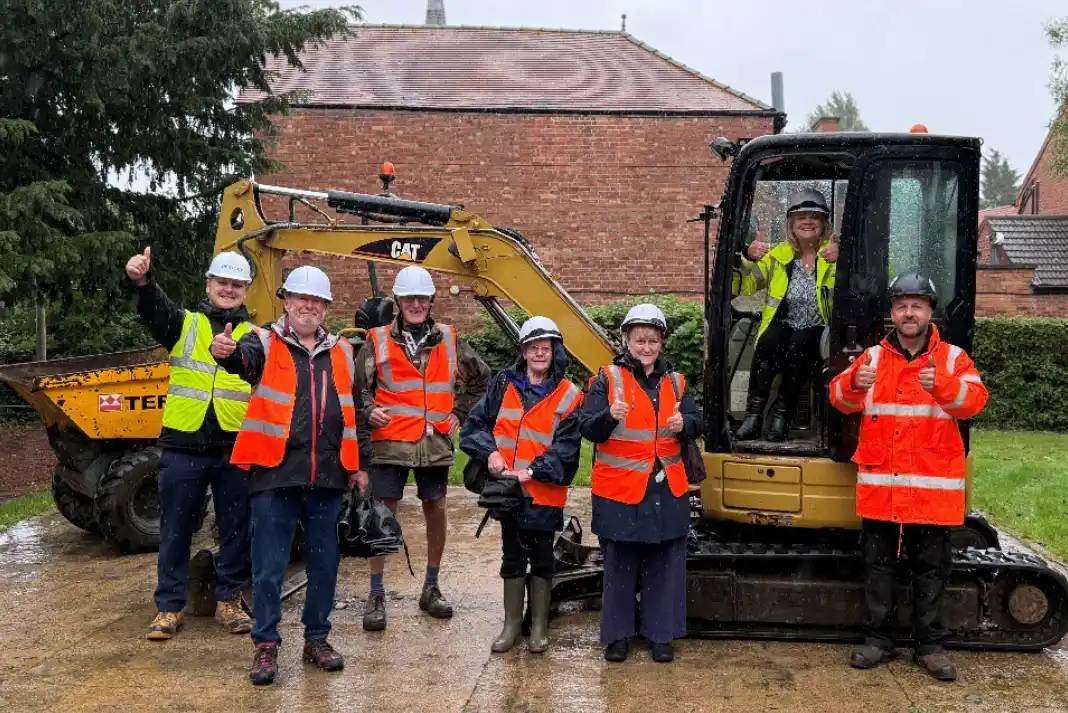
Families in Gedling borough are being encouraged to sign up to a new Trick or Treat Map, designed to keep things fun this Halloween.
Trick or Treat Map is free to use and lets households drop a pumpkin pin to be added as a trick-or-treat ‘Stop’. This shows families in the area which homes are taking part in the festivities.
Stops can be customised with opening timings and treats, and parents can filter categories like allergy-friendly or low-scare homes. This gives families the opportunity to plan more efficient, stress-free routes nearby.
The mum-of-three behind the new platform is Michelle Pearce-Burke,
Michelle said that the idea was born out of frustration.
“As a mum, I love Halloween,” she said.
“But wandering around with young kids, knocking on random doors and never knowing what to expect, just isn’t practical anymore,”
“I wanted to bring back that old-school neighbourhood spirit, but with a tool that works for modern families.”
The platform was originally soft-launched last year and is now available across the UK. Plans are also underway to kick-off the platform in the US and Australia too.
Within the tool’s first week of launching, over 5,000 homes across the UK signed up – and it’s only September.
Users can get involved in county-wide competitions for best pumpkins, decorations and more. Winners will be selected through a community vote and exclusive prizes are up for grabs.
Optional upgrades unlock additional areas and premium features.
Michelle continued: “It’s a modern twist on an old tradition. Giving parents peace of mind while keeping the neighbourhood spirit alive.”
Carlton looked good value for the half time lead given to them by Niall Davie but the home side turned the game on its head in the second half and goals from Roman Allen and Josh Green were enough the secure the win.
The Millers made three changes to the side which had lost at Matlock Town last time out with Niall Davie, Ewan Robson and Kieren Watson replacing Alex Howes, Khyle Sargent and Ash Chambers.
In what was the first ever meeting between the sides, Shifnal began well and Felix Annan was called on to make a couple of early saves. Carlton gradually imposed themselves on the game and on a fine playing surface they took control. Ollie Clark headed just wide from a Greg Tempest free kick while at the other end Abdulrasaq Alamu-Tajudeen also headed just over.
Kevin Da Veiga Monteiro put an effort for the home side over the top but it was Carlton who looked the more threatening and they took the lead towards the end of the half with a lovely goal. A ball out of defence was headed on by Clark to Watson who flicked it to his left into the path of Davie. He took a touch and then fired low past Andrew Wycherley in the home goal to give the visitors the lead to the delight of the small group of travelling supporters behind the goal.
Minutes later Watson fed Liam Bateman on the right. He whipped over a lovely cross which Tempest steered just wide. Next it was Niall Hylton’s turn to set up Watson but his shot was comfortably saved.
The dangerous Jack Loughran saw a cross cut out by Dean Freeman as the first half ended with the Millers in front.
Shifnal came out for the second half with a noticeable increase in energy which Carlton were unable to match. The equaliser came just before the hour when a deep cross from the left was headed home unmarked by Allen.
Carlton responded and Robson picked up a ball from Annan, fed Davie whose cross was headed just wide by Watson.
Annan himself made an excellent save to deny Jack Hodnett as Shifnal pressed forward. A series of corners followed as Carlton were unable to clear their lines. The third of these was a short corner routine with the ball fed to Josh Green on the edge of the box and he rifled the winner into the roof of the net.
Carlton made changes to try and stay in the competition but they rarely threatened the Shifnal goal. Indeed, but for some alert defending from Dan Brown and a fine save from Annan to deny Loughran, the scoreline could have been worse. As it was, with the rain teeming down on the players and soaked supporters, the Millers rather meekly limped out of the Trophy.
Carlton Town: F Annan, L Bateman (S Thompson-Harris 89), L Durow, D Brown, D Freeman, G Tempest, N Davie, E Robson (A Howes 82), K Watson (A Troke 71), O Clark (L Moran 82), N Hylton. Unused subs: K Sargent
Work has started on developing a community garden in Burton Joyce after the parish council secured more than £100k in funding for the facility.
The grant was awarded by FCC Communities Foundation. FCC who are a a not-for-profit business that awards money to community projects through the Landfill Communities Fund.
Now the cash has been secured, workers and project managers from Whiting Landscape can move onto the site and begin the long anticipated transformation of the garden.
Burton Joyce Parish Council expect the work to be completed before the end of November.
The new garden will include a canopy over hard standing, a variety of bench seating and soft landscaping with sensory and bee‑friendly planting.
Chair of the Parish Council, Cllr Laurence King said: “This project is the culmination of our determination as a village to create a welcoming and attractive ‘heart’ and amenity to the centre of Burton Joyce.
“Our thanks go to all who have contributed over a number of years to reach this point. We are excited to see it finally taking shape”
The Parish Council will be holding a grand opening event for the community and all those involved when the works are finished and will widely advertise this date as soon as it is confirmed.
Cheryl Raynor, FCC Communities Foundation Grant Manager, says: “We’re delighted to be supporting the Parish Council with this project, and pleased that work has now started on site. This is exciting and transformational work and we look forward to seeing the garden in its full glory at the opening event”.
A persistent dealer has been sent back to prison following a police investigation into drugs supply in Calverton.
Floyd Sneap’s home in Georges Lane was one of three properties raided by officers from the Gedling North neighbourhood policing team and other officers on March 26, 2025.
Sneap, aged 29, and his partner Hollie Howard were detained when the warrant was executed and searches of the address took place.
Officers found cocaine with a street value of around £4,000 as well as heroin, cannabis plants and cannabis cookies.
There was also a knuckle duster and a host of equipment associated with street dealing, including electric weighing scales, and bundles of cash.
A burner-style mobile phone was seized which showed Sneap had been supplying multiple drug users around the village.
Sneap, of Georges Lane, pleaded guilty to possession with intent to supply cocaine, heroin and cannabis.
At Nottingham Crown Court on Thursday (18) he was jailed for a total of five years and seven months.
Howard, aged 34, also of Georges Lane, admitted possession of a Class B drug and was conditionally discharged for 12 months on July 17 2025.
Detective Constable James Gill said: “Sneap’s sentencing follows a long-standing investigation into drug dealing in Calverton which was progressed over many months by the neighbourhood team.
“The warrants and ensuing CID investigation involved multiple policing teams working together to achieve this outcome in court.
“It was no surprise when the warrant was executed at Georges Lane to discover Sneap had been using his home as a base to supply drugs to vulnerable users in the area.
“Sneap has an unenviable record of previous offending, including a jail sentence for drug dealing as recently as 2023.
“Evidence on the phone revealed he had effectively messaged addicts in the village to say he was back open for business.
“Class A drugs continue to cause immeasurable harm in communities and street dealers like Sneap make profits from this misery so our efforts to disrupt the trade continue through proactive work like this.”
What can local rugby players expect this season? Plenty. Pre‑season is already alive with rumour, energy and a hint of promise. Players from Nottinghamians, the Notts, Lincs & Derbyshire club, will test themselves in Midlands 3 East (North‑West), aiming to push toward mid‑table or better. Meanwhile, those affiliated with Nottingham Rugby will eye the Championship with hope and grit. The pathway from grassroots to the RFU second tier remains clear and inspiring.
Among the betting enthusiasts, more and more punters are using non‑UK sports betting sites, 2025 data has so far shown. These sites often provide options like faster payouts but also take a chance on wider markets that may include local rugby matches. If you look at the odds for the upcoming Nottingham fixtures, you’ll find real prices. For example, Nottingham were priced at around 17/20 to beat Doncaster Knights back in early October, while the Knights edged slightly longer at around 1/1. That kind of detail matters. Players can sense the expectation and the challenge that awaits. But what matters most is what happens on the pitch.
For grassroots athletes, this season offers structure and clarity. The Nottinghamians’ first XV will tackle familiar travelling and tight local rivals. League matches won’t be easy. Results might hinge on fitness, set‑piece accuracy, and who turns up stronger. That experience builds toughness. Some players juggle university studies or day jobs alongside rugby. Their commitment sets a tone: training intensity will be high, regardless of final weekend number.
The step up to Nottingham Rugby is bigger still. The team will again compete in the RFU Championship, and early season form matters. Last term, they played 11 home matches with an average crowd of about 1,225. That support matters. A strong showing at Lady Bay can lift morale and earn vital points. Players returning to training will benefit from an atmosphere that’s energising. Fitness levels will be a dividing line, especially in the second half of matches.
Junior players should watch for opportunities. Several in Nottingham’s ranks moved on, Ellis Mee joined Scarlets, and others like Jordan Olowofela and Morgan Bunting transferred to Doncaster Knights, creating openings in the squad. That opens space for emerging talent to step in. University players, recent sign‑ons like Dan Richardson, Matthew Arden, Gwyn Parks, Ale Loman and others are already embedding themselves. Newcomers who show appetite and discipline could make an early impact, especially in early rounds against teams like Cornish Pirates or Hartpury.
Preparation will matter more than ever. Opponents are varied. One week brings Coventry, a tough fixture; the next sees Cambridge at home. That demands study and adaptability. Coaches will call for consistency and sharpness across attack and defence. Tactical drills. Communication under pressure. Even grassroots players can take a page from this approach. Hone the basics first.
For those watching the ladder, promotion is out of reach this season. Survival and stability in the Championship matters more. Compare that to Nottinghamians. Staying competitive and finishing above the bottom two is the goal. Stability there brings morale and makes space for improvement. Players in both setups should set small objectives. Did you win your set‑piece ball? Did you cover your channel? Did you track correctly? Season‑long gains come from such minor, consistent wins.
Off the field, fixture planning will test players too. Most players juggle other commitments. That means time management becomes a skill. If mid‑week sessions clash with work or study, players must choose wisely. Recovery counts a lot in modern sports. Planning ahead, aiming for rest and sustaining energy through the season can affect who stays available.
Somewhat quietly, rugby remains a community-driven sport. Fans, neighbours and local sponsors keep teams running. Young players enjoy seeing fixtures on pitch. They want to play for those banners. That sense of belonging can lift performances. If training grounds return to full numbers and families come streamside, it helps.
The season holds risks too. Injury‑free runs are rare. Long trips and mid‑week nights can strain bodies. Players must build preventive habits. Strength, stretching, nutrition, hydration—small habits protect availability. Clubs need to keep backups ready and foster resilience across the squad.
Still, the promise of real matches, fierce competition, and club pride will carry these players through. Rising players may even get noticed by higher‑level scouts or trial opportunities. Last season’s league outcomes showed that tight margins define careers, just as tight margins define local matches.
Whatever happens, local rugby lovers can look forward to weekends filled with effort, hope, and drama. Four‑try conversions, opportunistic turnovers, rushing line breaks or late defensive stands. Grassroots and Championship players alike will discover what matters: passion, community, and the chance to grow. The season ahead will test bodies and hearts. It will give players chances. The field awaits.
Blockchain technology is no longer just a buzzword. It’s being talked about in government offices, universities, and start-ups across the country. At its core, blockchain provides a digital ledger that’s secure, transparent, and almost impossible to alter. For local councils under pressure to improve efficiency and cut costs, the question is whether this technology could help manage public records more reliably.
Where Blockchain Is Already Making a Difference
While some view blockchain as futuristic, it’s already being used in a growing number of industries. In logistics, companies are using blockchain to track products across supply chains, improving accountability and reducing fraud. In real estate, digital contracts are now being trialled to make property sales faster and more transparent. Finance is another big adopter, with blockchain helping banks and fintech firms process payments more efficiently.
Entertainment and gaming have seen their own changes. The best crypto casinos 2025 has to offer are a good example of how blockchain can make systems faster, safer, and more user-friendly. These casinos allow for instant deposits, borderless transactions, and often offer higher levels of privacy than traditional platforms. They’ve shown how blockchain can deliver real benefits when speed and security are essential—two factors that also matter in public sector services.
How Public Records Work Today
At the local council level, public records are managed through a mix of paper files, spreadsheets, and digital databases. This includes everything from council tax payments and business licences to building permits and social housing lists. While many of these services are now digitised, there are still challenges around data accuracy, duplication, and access.
When residents move or businesses update details, multiple systems often need to be updated separately. Mistakes can happen, and when they do, they cause frustration for residents and delays for council workers. If these records were stored on a shared, time-stamped blockchain ledger, it would reduce errors and keep everyone working with the same set of up-to-date information.
Would Blockchain Make Things More Efficient?
The short answer is yes—eventually. With blockchain, each entry is permanent and traceable. That means if a change is made, it’s recorded, and you can always see who made it and when. This would make auditing far simpler. Councils could use the same system to store building applications, school admissions, or electoral roll updates. Instead of searching different databases or chasing paperwork, everything would be viewable in a secure, shared ledger.
It’s not just about efficiency either. Data security is a growing concern for councils. In recent years, several UK councils have experienced data breaches. Blockchain could reduce this risk by limiting who can change or access specific records, while still keeping a clear trail of activity. In theory, it creates more trust between public services and the people they serve.
Challenges That Still Need Solving
Of course, it’s not all straightforward. The cost of overhauling existing systems is high. Most local councils already work with tight budgets, and investing in new digital infrastructure isn’t easy. Staff would also need training, and there could be pushback from departments used to existing methods.
Then there’s the legal side. Public records are subject to strict data protection rules. Councils would need to ensure that using blockchain didn’t breach GDPR or expose sensitive information. There would need to be clear rules on who can see what, and how long records can be kept.
Despite these hurdles, pilot projects are already under way in some parts of Europe and Asia. They’re testing how blockchain could manage birth certificates, land titles, and court documents. If those trials succeed, the UK may not be far behind.
Conclusion
Local councils are under more pressure than ever to do more with less. Blockchain isn’t a perfect fix, but it could offer a more secure and efficient way to manage public records. While full-scale adoption is likely years away, the benefits are becoming harder to ignore. If handled carefully, the technology could help councils work smarter—and build greater trust with the communities they serve.
Nottinghamshire councillors are conflicted over where a fourth road bridge over the River Trent should be built after a new location was suggested.
Nottingham is currently served by Lady Bay Bridge, Clifton Bridge, and Trent Bridge, but local politicians have argued that a fourth road bridge would help further relieve traffic jams across the city and beyond.
While a crossing at Trent Basin is currently being built by Nottingham City Council for cyclists and pedestrians, the last road bridge was built decades ago.
In March, before Reform took control of Nottinghamshire County Councillor Mike Adams secured money for a study into a fourth bridge over the river at Colwick.
In March, before Reform took control of Nottinghamshire County Councillor Mike Adams s(inset,left) ecured money for a study into a fourth bridge over the river at Colwick.
But during a Full Council meeting on Thursday (September 18) a location further to the north of the county – in Bassetlaw – was suggested by a Reform councillor.
Nottinghamshire county councillor Mike Robertson, who represents the Misterton division, said there is only one bridge over the Trent within an 18-mile radius in that part of the county.
The existing single-carriageway Flood Road bridge connects Beckingham in Nottinghamshire to Gainsborough in Lincolnshire.
He said the road was closed in 2024 when the river breached its banks, causing significant traffic problems – and added a fourth crossing in the area could better serve the planned STEP nuclear fusion power plant in West Burton.
“The A631 is the arterial route between Doncaster and Gainsborough,” Cllr Robertson said.
“It dissects my division and is the main transport connection for all of my residents.
“As I explained in my previous contributions my division is very much a cross-border area, with residents having links to South Yorkshire and Lincolnshire. Many have employment in Gainsborough or the West Lindsay area. Children from the division attend schools in Gainsborough with many also having family there.
“With the area only having one crossing of the Trent within 18 miles, this is a vital piece of infrastructure that supports local lives and economy. When it fails, which it frequently does, the area is massively impacted.
“Having such limited infrastructure has a massive impact on residents and businesses in my division, but also across the river in Gainsborough and West Lindsay.
“As elected leaders, we should focus on the benefits of geography, not just the authority. What the area needs is an additional crossing of the Trent fit for the 21st Century, enabling residents and businesses to cross the river without impediment.
“With Reform leading the county administrations on both sides of the river and a regional mayor in Lincolnshire, we should be looking to deliver a crossing to benefit the whole area.”
A debate over a new road crossing across the river was held back in 2022 in parliament, after traffic problems became particularly apparent following the closure of Clifton Bridge in 2020 due to structural problems.
Some lanes on the bridge were closed for more than 20 months while repair work took place, and initial closures made Nottingham one of the world’s most congested cities at the time.
County councillor Mike Adams, who represents Carlton East for the Conservatives, said he had been campaigning for a new bridge at Colwick for years.
He told the Local Democracy Reporting Service the location proposed by Reform “will be great for Lincolnshire” – not necessarily a wider area of Nottinghamshire.
“The fourth Trent crossing near Colwick will be the single biggest infrastructure project the East Midlands has seen,” he said.
“It will connect Gedling borough to a major transport artery in either the A46 or A52.
“We will see jobs created both in its construction, existing businesses to expand, and new businesses to form. An example is the reduction in journeys from waste treatment plants owned by Veolia, Biff and Enva, based at Colwick, making it easier to access the residential, public sector, and business customers it services.
“It will make our road network resilient to failures in the existing bridge infrastructure across Nottingham.
“A fourth Trent crossing is not just my choice, not just thought up recently, it’s the residents’ choice. It has been talked about for decades.
“We need to back the residents who overwhelmingly want this.
“Let’s be honest; anywhere else will not see the benefit to the whole of Nottinghamshire as this connection will bring.”
The location for a new bridge has been a contentious issue.
A new structure at Radcliffe was recommended in 2004, and Gedling Borough Council proposed one at Holme Pierrepont in 2014.
The new study will assess all options, including the preference of many for a new bridge at Colwick, with updates expected later this year.
The study was funded using money from the East Midlands Combined County Authority (EMCCA).
A plan to make it simpler for councillors to impose 20mph limits on roads across Nottinghamshire has been thrown out and branded “political overreach”.
Nottinghamshire County Council’s Labour group had been looking to get the Reform-led authority to support the implementation of 20mph speed limits on residential roads in areas where residents request and generally support them.
The plan would have excluded A-roads.
The group said a blanket change to speed limits in residential areas in Wales had led to almost 900 fewer people being injured as a result.
But the law change by the Welsh government has proven controversial to some, with the cost of implementation estimated to be £34m, reports say.
Labour county councillor Penny Gowland proposed a motion to get the council’s support to make it easier for councillors to make the changes, during a meeting on Thursday (September 18).
However both the leading Reform group and the Nottinghamshire Conservatives rejected the motion, with some members claiming it was “political overreach”.
Cllr James Rawson (Ref) said: “Without doubt lower speed limits make sense outside schools, hospitals, and other dangerous areas. This is obvious to all.
“Let us look at the evidence available in Wales. One Welsh MP quotes: ‘the roll-out has already cost taxpayers £32m, with an estimated economic hit of £9bn’.
“For me to approve this motion means more costs, more red tape, more strain on the busy working men and women who are trying to make ends meet, more left-leaning political overreach. If speeding is a problem the police must prosecute more speeding drivers.
“The common sense majority should not be made to suffer.”
Cllr Keith Girling (Con) suggested councillors purchase a speed gun and take the matter of keeping motorists in check into their own hands.
“The problem is with changing speed limits, and there are loads of roads in Nottinghamshire – where it has been influenced by local councillors – where it is 50mph, then it is 40, then 30, then 50, then 60, and I’ve got the points to prove it, is it can get quite confusing,” he added.
Cllr Gowland said: “One thing I heard on the radio the other day is 20mph limits are things liberals want, well I can promise you I’m not a liberal, not in any meaning of the word liberal. Car speed affects everybody.”
She said the Labour group was only seeking to make it easier for 20mph limits to be imposed in residential areas to avoid “overreach”.
Cllr Gowland said there were difficulties getting speed limits changed because it is not currently council policy.
Cllr Helen Faccio (Lab) added: “I want to stress this motion is about residential areas, predominantly suburban areas.
“My 10-year-old has just started walking to school by himself, my biggest fear – I live in a suburban area – is that he is going to get hit by a car walking to school. We all know a child is more likely to survive if they are hit at 20mph, than 30mph.”
Nationally, under guidance from the Department for Transport – which was revised in March 2024 – the Government has now given local councils the power to introduce 20 mph restrictions on residential roads.
Government guidance says traffic authorities should only introduce 20mph limits and zones in the right places, over time, and with local support in urban areas and built-up village streets that are primarily residential.
Britain has long been a hotbed for Roman artefacts and discoveries. Famously, the Roman Empire came to try to conquer the British Isles, but found the task to be much more difficult than expected. They certainly left their mark and continue to be culturally significant, but the legacy is one of needing to quash rebellion even while bringing civilisation and advanced technology to the mainland.
As the Roman Empire shrank, it left behind many of its grandest creations. After centuries of finding these artefacts, we’ve created a strong sense of the Roman times in Britain, but one reoccurring and distinctly ornate artefact continues to puzzle Romanologists. That artefact is a dodecahedron, which is now on show in Nottingham but only until the middle of January next year.
The Mysterious Roman Dodecahedron
One of many grand artefacts found in Norton Disney, Lincolnshire, at the Potter Hill site in the summer of 2023, the Roman dodecahedron is novel for many different reasons. Not only is its purpose unknown, but the potential ornament is distinctly ornate in its design. With extra baubles dotted around, and circular holes cut into the sides, it’s an unforgettable sight. Further, this dodecahedron is particularly well-preserved.
It’s not the only dodecahedron found. However, as is reported by the BBC, this one was found complete and in remarkable condition. Most others, but not all, were found damaged or in too many fragments to be pieced together. With this complete artefact, all others can be better understood. Yet, even with 33 other examples found in Britain, the purpose of the 8cm tall, 254g piece is unknown.
Having survived in this superb condition for some 1,7000 years, its site could finally reveal the secrets behind its purpose. For now, to pique the interests of any and all intrigued by our Roman history, the mysterious dodecahedron is on show at the University of Nottingham Museum at Lakeside Arts. It first came on show on 25 July and will only be available for visitors to see until 18 January 2026.
Expanding the British Fascination with our Roman Past
From Claudius’ initial invasion in AD 43 to Rome turning its back on the ruling seat of Britain in the 5th Century, much of Britain was ruled by the Romans for over 350 years. In doing so, Rome had a huge influence on the trajectory of the oft-invaded island and continues to be among the most popular points of interest in our history. Naturally, along with the many Roman exhibits at museums, entertainment renditions of those days remain a hit.
You can see this from the most advertised corners of entertainment to the newest types of digital entertainment. On the latter, the leading online casino and its live casino in the UK are the prime example. The game shows and table games played live regularly tap into popular themes, as shown by Treasure Island and Balloon Race Live. Slots also do this regularly, with some of the most popular games in the UK at the live casinos site being Shields of Rome and Roamin’ Romans.
On TV and the big screen, the popularity of Roman productions also remains high in Britain. The German show Barbarians on Netflix earned tremendous acclaim and a solid audience in the UK. Even bigger than that, though, the comedy and historical drama Britannia went big on the mysticism of the Celtic tribes and the threat they posed to Rome. Even on the big screen, the distinctly lacking Gladiator II still managed to earn over $40 million at the UK box office.
Rome will never fade as an enticing setting for the British, and now, in Nottingham, we get a unique look at one of the most mysterious aspects of the empire that tried for centuries to tame these shores.
Carlton East councillor Mike Adams, has presented a petition to Nottinghamshire County Council signed by more than 450 residents, calling forurgent action to tackle recurring flooding along Whitworth Drive and Nottingham Road.
The petition was formally handed in at the Full Council meeting on Thursday 18th September, following months of campaigning by Cllr Adams. It marks the latest step in hisefforts to secure a permanent solution to a flooding problem that has blighted local residents for six consecutive winters.
The petition, which began in May, quickly gathered widespread support from families, commuters, and school communities affected by the annual chaos. In his speech to the CouncilChamber, Cllr Adams reinforced the strength of feeling among residents.
“Over 450 people have signed this petition. That’s 450 voices saying loud and clear: this problem must be fixed,” he told councillors.
“This isn’t just about water on the road – it’s about children forced onto the A612, residents unable to leave their homes safely, and a community that deserves better. The scale of support shows just how desperate people are for a long-term solution.”
Cllr Adams has long argued that the answer lies in installing kerbside drainage along Nottingham Road and expanding the outflow pipe at the end of Whitworth Drive to prevent the dyke from becoming overwhelmed.
“The message from our community could not be clearer,” he added. “Temporary fixes and sticking plasters are not enough. We need proper infrastructure upgrades to protect peopleand restore confidence before another winter sets in.”
The petition will now be formally considered by Nottinghamshire County Council. Cllr Adams vowed to continue pressing the issue until a sustainable solution is delivered.