


There is a persistent belief among founders that if the FDA has not defined a marketing term, the term is safe to use. The opposite is closer to true. Undefined terms are the ones most likely to draw an enforcement letter, because the agency evaluating them is not the FDA.
Start with the cleanest example. On “hypoallergenic,” the FDA’s own position is that no federal standards or definitions govern the term. The agency tried to fix that in 1975 with a regulation requiring comparative testing. Almay and Clinique challenged it, and the DC Circuit struck it down on the ground that the FDA had not shown consumers understood the term the way the agency defined it. The FDA’s page on the subject ends with a sentence worth pinning above a marketing desk: the term means whatever a particular company wants it to mean.
The same reasoning applies to “clean,” “gentle,” “dermatologist tested,” “non-comedogenic,” and “pH balanced.”
Who actually polices the undefined terms
The FTC. Its Health Products Compliance Guidance, issued December 2022, requires competent and reliable scientific evidence for health-related claims, meaning tests, analyses, research, or studies conducted and evaluated objectively by qualified experts and generally accepted in the profession. Randomized controlled human trials sit at the top of that hierarchy. Animal and in vitro work alone will not carry a human claim. Consumer anecdotes, in the FTC’s words, are never sufficient.
Two features of that guidance catch small brands repeatedly. Marketers are responsible for claims that are suggested or reasonably implied, not just the words on the page. And the FTC makes no bright-line distinction between categories of health-related products, so a cosmetic claim gets analyzed with the same tools as a supplement claim.
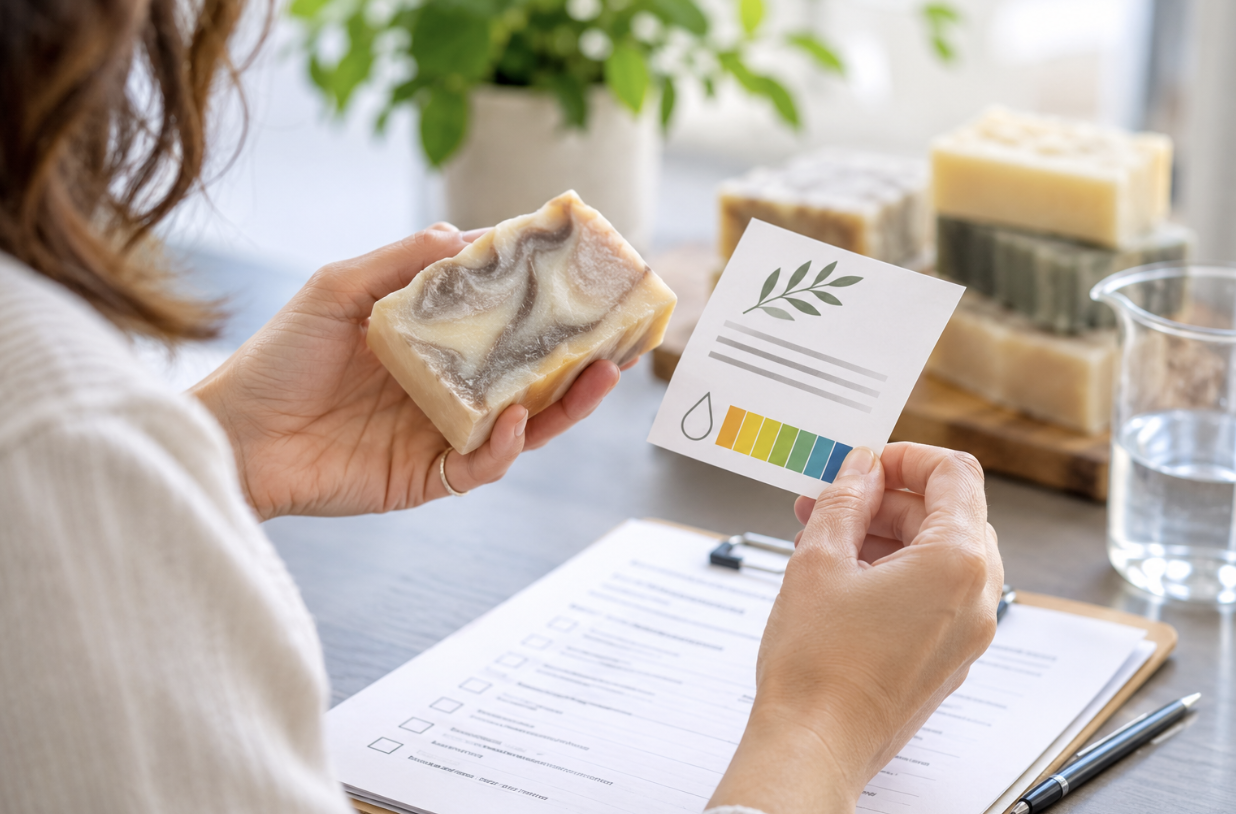
Apply that to “pH balanced.” As a bare factual statement that the finished product’s pH sits inside a defined range, it is sustainable with a batch result measured by a stated method against a stated specification. Publicly documented figures such as the typical soap ph level for a given format make that kind of factual claim straightforward to support. The exposure starts when the claim carries an implied benefit. If the phrase is presented as meaning less irritation, a restored barrier, or a healthier skin microbiome, the implied benefit becomes the claim requiring substantiation, and a pH meter reading is not evidence of a clinical outcome.
The line that turns a cosmetic into a drug
The statutory test is intended for use, established through labeling, advertising, consumer perception, and well-known ingredient properties. Cosmetics are intended for cleansing, beautifying, promoting attractiveness, or altering appearance. Drugs are intended to diagnose, cure, mitigate, treat, or prevent disease, or to affect the structure or any function of the body.

The FDA’s own examples of claims that cross over: restoring hair growth, reducing cellulite, treating varicose veins, altering melanin production, regenerating cells. A fragrance sold with a claim that it helps you sleep is a drug. The same fragrance sold as attractive is a cosmetic.
The agency does not pre-approve claims and maintains no list of accepted ones. In April 2026 it issued a warning letter to a Michigan contract manufacturer over two products whose names alone, referencing shingles and genital herpes relief, established drug intent without approval. That letter also cited something new: inappropriate reliance on artificial intelligence to generate specifications and procedures without adequate human review, charged as a quality unit failure.
Green claims run on a 2012 rulebook
The FTC opened its review of the Green Guides in December 2022. Revisions expected in 2025 had still not been finalized as of spring 2026, so the operative text remains the 2012 version at 16 CFR Part 260. Its provisions are more specific than most marketing teams assume.
- General benefit claims, section 260.4. Unqualified claims such as eco-friendly, green, or sustainable are not permitted, because they convey far-reaching benefits the product almost certainly cannot support. Qualify to a named benefit.
- Free-of claims, section 260.9. Deceptive where the product contains substances posing similar risks to the named absent one, and deceptive where the substance was never associated with the product category in the first place. That second clause is the one beauty marketing trips over constantly.
- Non-toxic, section 260.10. Reads as non-toxic for humans and the environment, and requires competent and reliable scientific evidence for both.
- Recyclable, section 260.12. Unqualified claims require facilities available to a substantial majority of consumers where the item is sold, and the guides define substantial majority as at least 60%.
- Degradable, section 260.8. Deceptive unless the item completely decomposes within one year of customary disposal, which rules it out for anything headed to a landfill.
On “organic,” the FDA notes the term is not defined in the laws it enforces. USDA’s National Organic Program governs the claim, and a cosmetic making it must satisfy both USDA rules for the claim and FDA rules for labeling and safety.
Where MoCRA actually stands
In force now: facility registration and product listing, which the FDA began enforcing July 1, 2024, with biennial registration renewal and annual listing updates. Serious adverse event reporting within 15 business days, with records held six years, or three for qualifying small businesses. Safety substantiation records, required since December 2023. And since December 29, 2024, a domestic address, phone number, or electronic contact on the label for adverse event reports.
Not in force: the GMP rule, due in December 2025 and never proposed. The fragrance allergen labeling rule, which has slipped repeatedly. The talc testing rule, proposed in December 2024 and withdrawn in November 2025. The formaldehyde hair-smoothing ban, which missed its target and has no new date.
The small business exemption covers firms averaging under $1 million in annual US cosmetic sales over three years, and it exempts them from GMP, registration, and listing only. Labeling, adverse event reporting, safety substantiation, and the FDA’s records access and recall authority still apply.
One more exposure most brands forget
The FTC’s Consumer Reviews and Testimonials Rule took effect October 21, 2024. It prohibits fake reviews including AI-generated ones, compensation conditioned on a particular sentiment, undisclosed insider reviews, and suppressing negative reviews through threats. In December 2025 the FTC sent warning letters to ten companies and noted civil penalties can reach $53,088 per violation.
What to do with all of this
Keep a substantiation file per claim, not per product, and note which evidence supports which sentence. Read your own copy for implied claims rather than stated ones.
And be clear about who is responsible. The responsible person under MoCRA is the manufacturer, packer, or distributor whose name appears on the label. If you work with a private label soap company or any other contract partner, the regulatory obligation for claims, labeling, and safety records follows your name, not theirs.