


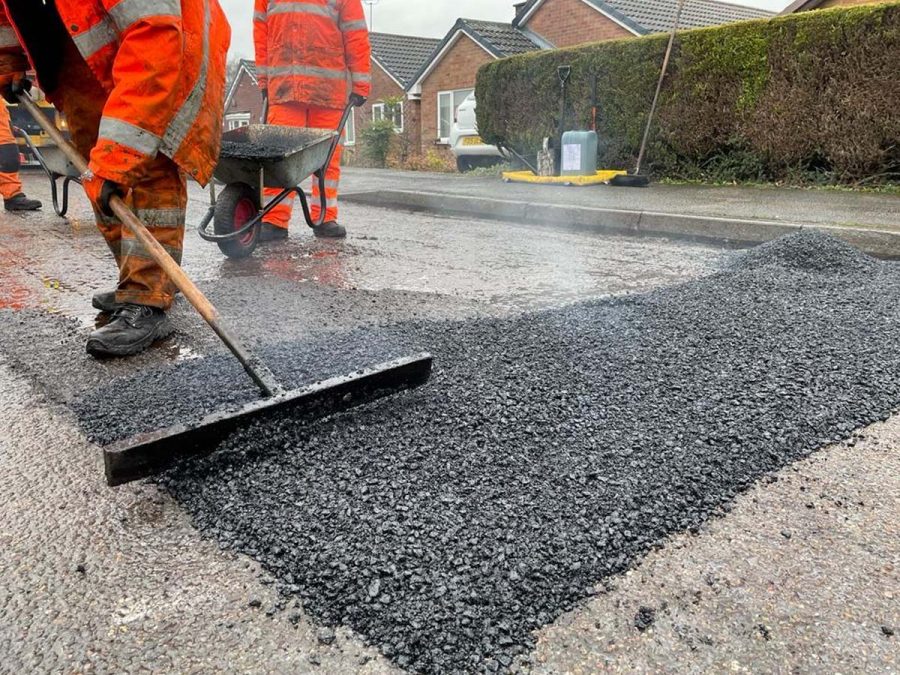

Patching teams have started work replacing some of the county’s most potholed roads after Nottinghamshire County Council revealed plans to spend £15 million improving the state of the county’s highways.
Workers from Via East Midlands, the authority’s highways contractor, were trialling new methods of permanent road replacements after the council brought in root and branch changes to its much-criticised repair methods.
The council plans to move away from temporary pothole fixes in favour of a “right repair, right-first-time” approach, delivering longer-term work “whenever possible”.
It follows figures obtained by the Local Democracy Reporting Service last year showing the authority repaired 476,000 potholes over the past five years, with the year-on-year number of temporary repairs on the rise.
The Conservative-led authority launched its all-party highways review panel last year to address the issue, with several meetings held throughout 2021 to discuss current repair methods and attempts to find new solutions.
Two external assessments of the authority’s current methods were ordered – one by consultants WSP and a second by the Local Government Association,
The assessments found the council should shift away from temporary repairs using a method known as Viafix and focus on permanent road replacement schemes.
Viafix – a form of cold asphalt repair which fills in specific holes – would still be needed to “protect the safety of road users” in the event of an emergency.
But the authority was told it should be using other forms of repair which replace whole stretches of road when it can.
Now the council has put this into action after conducting its permanent repair work on Holbeck Way in Rainworth.
The method involves using patching planers attached to a ‘Bobcat’ vehicle, which plains the top level of worn road surfaces before filling it with hot materials.
It will be typical of what the newly-announced patching gangs will be delivering across the county, with the authority’s £15 million to double the council’s patching teams from four to eight.
Speaking as the work was taking place on Monday (February 14), Councillor Neil Clarke (Con), chairman of the authority’s transport and environment committee, said: “This is a great example of our new approach to road repairs.
“We’re investing an additional £15 million into our road repairs and this is part and parcel of our new patching teams.
“We’ve doubled the number of teams working on our roads to have long-term patching repairs rather than short-term pothole repairs, so we’re now able to really get to grips with improving the roads for the people of Nottinghamshire.”
But he added: “It will certainly lead to a reduction in the pothole repairs [but] we’re never going to be able to say goodbye completely, there’s always going to be an emergency that needs a quick repair somewhere.
“But our emphasis is to have long-term, large patch repairs and that’s why we’re doubling those teams, so people will see they are better than those small pothole repairs.”
Alongside doubling the number of patching teams, the authority is also moving towards a three-year plan for road repairs to give more “clarity” to residents on when their streets will be targeted.
At present, the authority works on a one-year programme for road replacements and capital investment.
Ian Patchett, head of highway assets and development at Via East Midlands, explained more about the work of the patching teams.
He said: “We use what’s called a Bobcat plainer, a ride-on machine with a drum on the back which rotates and chews up the surface.
“That all gets swept off and taken onto a lorry to be used elsewhere. It removes the top surface and you get down to something solid, that you can then lay a new surface onto.
“Teams will also pick up other areas where there are cracking and where potholes may have not appeared yet. This is why it’s called preventative maintenance, to stop them appearing in the first place.”
Members of the authority’s transport and environment committee approved plans for the additional £15 million when councillors met last week.
Its full approval is subject to the full council meeting approving the wider budget on February 24.