




Different ways to bet or the way tournaments are set up impact how different bettors evaluate a wager placed between two teams during the course of a long season versus how they evaluate a wager on one game between two teams during the course of a tournament. Different bettors at sites like https://1xbet.ie/en/mobile evaluate their wagers differently because of the nature of the tournaments they are betting on. This provides insight into how differently structured tournaments impact the pricing of different types of outcome-based wagers on those events.
Leagues reward depth, not single peaks
In a round-robin wagering scenario, one of several possible outcomes may be:
- A change in the true-signal level of each team as the tournament progresses
- Fewer examples of upsets for teams that did not play in the previous round
- Ability to see more patterns within rosters and rotations as compared to past rounds
- Teams under schedule pressure
Levels of predictability among all teams will be very inconsistent from week-to-week, with particular first-round matches dating back to being relatively chaotic due to inordinate levels of variance found between matches in terms of the level of motivation for competing teams.
Group stages create two realities at once
The view of group stages of tournaments is that they sit as an intermediary between league play and knockout tournament games. Teams play multiple matches against each other to see how they perform versus their competitors. Teams aren’t trying to win each match as much as they are trying to qualify for the next stage of the tournament. The ability to qualify will have a significant impact on the pace of the game, use of bench players, and level of tactical risk taken during games.
Knockouts amplify pressure and variance
As luck would have it, there may be an unfortunate turn of events that sees you vanquished from contention. When you assess the outcomes between competing teams, there will be randomness due to the different possibilities that exist for each team to win a specific game. When comparing teams who play in a two-legged fixture, they would be much less likely to be affected by random variance than had they played only one leg of that fixture. The reason is that having that experience allows for opportunities to improve performance before actually crossing paths again. Moreover, the addition of penalty kicks and additional time would create even more uncertainty due to the fact that one of the teams may have its back against the wall after losing.
A practical note fits naturally here: during registration, entering the promo code 1x_3831408 can increase the maximum first deposit bonus. Bonus size and rollover rules depend on the current offer terms, so checking conditions before the first deposit matters.
Seeding and bracket design change who meets whom
Seeding regulations affect the layout of the tournament and create an opportunity for the top teams to advance into subsequent rounds without playing against one another earlier in the tournament, and a random draw will create the opposite scenario.
The following diagram depicts how each of the various tournament structures, which are all part of the seeding regulations, and how they fit within these structures, can create differing levels of uncertainty in a tournament.
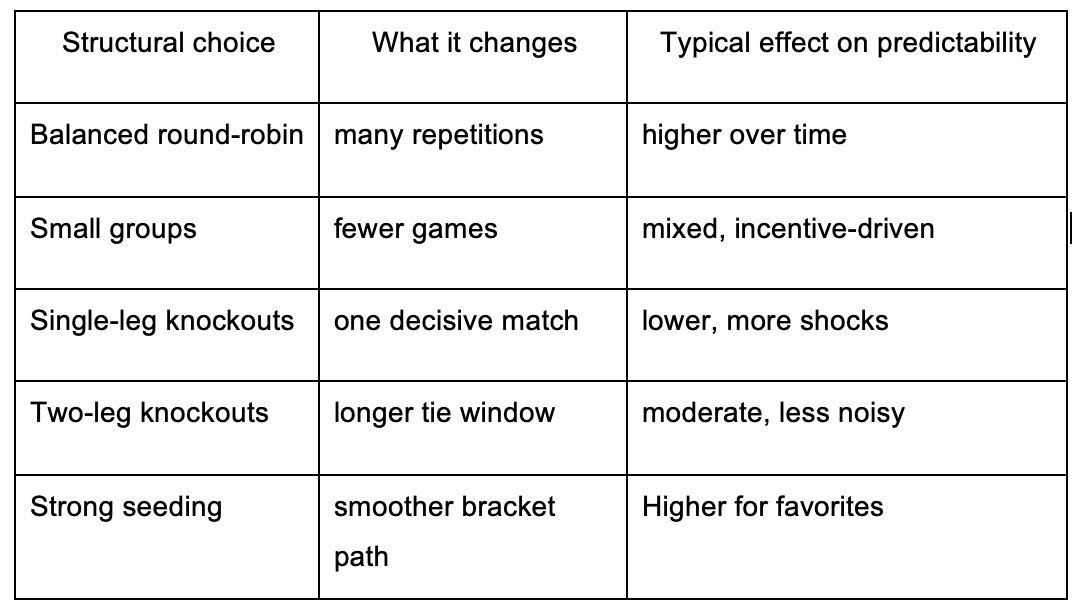
Scheduling tournaments affects many different parameters, including rest time between games and travel distances for all competing teams. It’s also about rotating teams and the degree of unpredictability experienced by each team participating in the tournament. As schedules become more compacted, differences in teams within difficult environments usually diminish with respect to how well the team performed due to differences in the team’s overall depth. However, teams competing in a tournament when there are built-in rest days, minimal travel distance for each team, and incentive structures that are simple to understand will experience a higher degree of predictability than they would normally experience.
Reading predictability without overfitting
The tournament format is a context layer that allows you to think of a team as essentially being the same team that played in the quarterfinals. While betting markets consider both – what to bet on based on the format of all tournaments, as well as give equal weight to how a team performs over the past few events, some teams are more suited to the structure.
Tournament format doesn’t create tournament outcomes. It establishes the characteristics of the outcomes created through the format. If you understand the reasonable range of possible outcomes through each tournament’s format, you can evaluate your correct predictions better.