After weathering early Graham ST pressure Arnold took the lead on 17 mins with a smart finish from last week’s scorer Curtis Millward after good work from Dillon Bird.
PICTURED: Arnold in action against Graham St Prims (Picture: Jim Bethall)
Unfortunately for the Eagles that was a good as it got. Similarly to last week we conceded almost immediately with Bhupinder Aieten heading in from a corner. Three minutes later the visitors went ahead when Bradley Scard headed home from close range. With half an hour played, Scard was on the mark again, this time firing past home keeper James Elliott with four defenders failing to block his path to goal.
Arnold actually responded well with first Connor Winstanley missing a guilt edged chance when through on goal, before further chances from Bird and then Jordan Knight hit a sweet volley that the keeper did well to tip around the post. H-T 1-3
Into the second period and Prims went even further ahead on the hour mark, Brandon Gwinnutt heading home from a corner – the header had no power, but was well directed, missing all of the home defenders on its way into the back of the net.
Michael Fitzhugh forced Prim’s keeper Fretwell into making a couple of saves midway through the half, he then fired over when he was picked out unmarked at the far stick. Things got worse for Arnold with 10 to play, sub Dom Wilkinson stabbed home from close range with his first touch! Kurt Dallison added the final nail in Arnold’s coffin on 85, firing across Elliott from the corner of the box.
Prims were then awarded a penalty after Joss Whitely was guilty of upending a Prim’s player in the box. The Arnold no. 5 received a red for the offence. The penalty kick was well saved by Elliott. F-T 1-6
Lots for the Eagles Management to think about before Tuesday night’s trip to Clipstone FC…
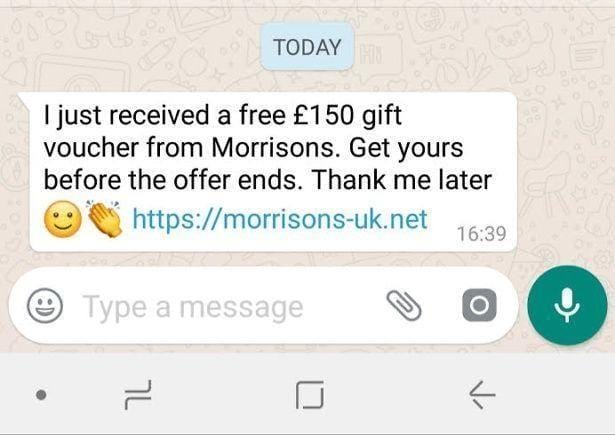
Scam artists have been targeting people in the borough with fake Morrisons and Sainsbury’s £150 vouchers in a bid to get them to part with personal details on WhatsApp.
Consumer watchdog Which?, who issued the warning, said the messages come with a link to an online survey which then asks for their email, home address and phone number in exchange for the free voucher.
PICTURED: Scam message (PICTURE: Which?)
A text shared with Gedling Eye over the messaging app read: “I just received a free £150 gift voucher from Morrisons. Get yours before the offer ends. Thank me later.”
Once the victim has completed the survey, they are then asked to select other WhatsApp pals to share the link with.
Which? say that because the message comes from a friend, it makes it more believable.
Both supermarket chains have confirmed the offer is a scam.
A spokesman for Sainsbury’s said: “Customers should always be mindful of phishing scams. This message is not from Sainsbury’s and we are advising customers to delete it.”
Health chiefs are targeting social media users in Gedling borough with a new campaign which aims to stop them scrolling through sites for one month in a bid to boost their mental health.
The UK’s Royal Society for Public Health (RSPH) is calling on people to stop using platforms such as Facebook, Instagram, Twitter and Snapchat in September — or to cut down the amount of time they spend on the platforms.
The Scroll Free September campaign has been launched amid growing concern about the impact of social media on mental health.
The campaign follows in the footsteps of health awareness months such as Dry January, when people cut back on alcohol, and Stoptober, when smokers are encouraged to quit.
Shirley Cramer, chief executive of RSPH, said Scroll Free September gives users in the borough the chance “to take back control of our relationship with social media”.
Claire Murdoch, NHS England’s national director for mental health, said: “Scroll Free is right to highlight growing concerns that social media is contributing to increasing mental health issues in young people and a major ramp up of services will be needed to deal with the problems as part of the NHS 10-year plan.”
“We need to see concerted action, with everyone taking responsibility, including social media giants, so the NHS is not left to pick up the pieces of a mental health epidemic in the next generation.”
Those in the borough taking part in the campaign, which runs from September 1 to September 30, will be encouraged to stop using or cut down time on personal social media accounts.
They can continue using instant messaging platforms and social media for work.
Gedling Eye now has a Whatsapp group so you can keep up to date with the latest news from across the borough. We will send you one message a day with our main headlines, as well as the big breaking news alerts. To sign up text NEWS to 07958532672. Make sure you add the number to your contacts as ‘Gedling Eye’. We won’t share your phone number or use it anywhere else.
People in Gedling borough are being warned not to fall for this latest scam after a number of people in the area were targeted.
The potential victim receives a threatening voicemail or automated message being left on your phone from someone pretending to be from HM Revenue and Customs.
The call demands money or threatens a lawsuit is being brought against you from HMRC.
However, the organisation has confirmed that this is a scam and should be ignored.
A man from Netherfield who didn’t wish to be named got in touch with Gedling Eye after receiving a call.
He described the moment he heard the voicemail as ‘terrifying’.
He said: “I run my own business so occasionally I get calls from them about payments due or admin stuff I need to do.
“It’s been a tough summer, so when I heard I might owe them money, my heart was in my mouth as I’d struggle to pay.
“It was only when I called HMRC that they assured me it was a scam. It was a real relief.”
If you've received a threatening voicemail or automated call demanding money, claiming to be from ‘HMRC’, this is a scam. Please do not comply and report anything suspicious to us https://t.co/tTcgyjp7Ohpic.twitter.com/TKLzPrMN37
If you receive such a call, you are encouraged to report it to HMRC.
Gedling Eye now has a Whatsapp group so you can keep up to date with the latest news from across the borough. We will send you one message a day with our main headlines, as well as the big breaking news alerts. To sign up text NEWS to 07958532672. Make sure you add the number to your contacts as ‘Gedling Eye’. We won’t share your phone number or use it anywhere else.
A forensic psychologist from Nottinghamshire, who gives expert advice in court for trials relating to violent crime, is urging parents in Gedling borough to talk to their children about the dangers of knife crime.
Crime in Nottinghamshire soared by 29 percent in the last year – with more than 20,000 extra incidents recorded in the area. This includes a sharp rise in knife crime – a 10.8% increase from last year’s figures, with 822 serious offences involving a knife already committed this year.
PICTURED: Dr Ruth Tully
Knife crime and the consequences of these crimes can cause a huge worry parents. It is becoming the norm to see reports about the increase in gang culture, injuries, fatalities, criminal convictions, and youths feeling threatened. In the last three months there have been 15 serious incidents involving a knife across Nottinghamshire.
Dr Ruth Tully is an expert in her field and has examined and given evidence in some tragic cases. She wants to help tackle the issue of knife crime in youths.
She said: “In recent times we’ve seen more diversity in the types of weapon that people use to cause offences.
“For example, knife crime is increasingly in the media but so are acid attacks and firearms offences.
“Ultimately the availablity of weapons is a crucial factor in a person’s choice to carry and use them. Any type of weapon can cause serious harm, as we see on an almost daily basis in the news.”
Dr Ruth Tully’s top tips for parents on knife crime prevention:
1. Talk about knife crime
It’s important to have these conversations with children so that they understand what knife crime is and know the effect that it would have on you and them if they carried a knife, were caught with a knife, or were injured.
Reassure them that they can speak to you about anything they are worried about and that you won’t judge. It’s better to address any problems at an early stage before they have a chance to escalate.
2. Understand why people carry knives and other weapons
I often get asked why people carry knives and why they engage in such serious offences.
Having worked with many violent offenders who have used knives, the motivations can be quite different. Some people might carry knives because they feel it gives them self-protection, others might think it gives them status, whether that’s with their peers or in general.
Some people use a weapon to try to threaten and intimidate somebody and when that’s escalated, they have been prepared to use the weapon and caused serious harm.
3. Be aware of the consequences
Let your children know how their actions can affect everyone else in the family. How would everyone feel if they were injured or arrested? Could they be putting other family members at risk if they get involved in violence and gangs?
4. And be aware of the dangers
Many knives are used against their owner, and people need to be aware that carrying a knife opens people up to being involved in an attack. It’s important to teach children that walking away from any kind of confrontation or altercation is the best thing to do, and seeking advice from trusted adults or agencies like the police can really help. It’s important to also teach children that the police are there to help, not just there to catch people doing something wrong.
5. Research
It’s useful to try to use facts to back up what you are saying. You can look at case studies and campaigns which can be hard hitting at getting across the consequences that knife crime can have. Try and encourage positive choices, and be open with your child if you think they are getting involved in knife culture. It’s not as simple as offering pro-social alternatives, otherwise we would have solved the problem by now, but if there are activities your child might be interested in that will put them into contact with pro-social others, then this can be useful and give them something different to focus their time on.
Gedling Eye now has a Whatsapp group so you can keep up to date with the latest news from across the borough. We will send you one message a day with our main headlines, as well as the big breaking news alerts. To sign up text NEWS to 07958532672. Make sure you add the number to your contacts as ‘Gedling Eye’. We won’t share your phone number or use it anywhere else.
Star Wars fans are in for a real ‘tweet’ later this month.
Fans of the famous film franchise are being given the chance to pose for pics with their favourite characters to help raise funds for a hospice in Mapperley.
Members of the Star Wars costume group East Midlands Garrison will be posing for photos at the R2 Tweet2 robin at Victoria Centre Market, Nottingham, to raise vital funds for Nottinghamshire Hospice.
Characters in attendance including Boba Fett, Jawa, Han Solo and Princess Leia, Imperial Troops, and an Imperial Officer will pose with members of the public for a suggested donation of £3 – which will go towards for hospice funds.
The event takes place on Thursday, August 23 between 10.30am-12pm and 1pm-2.30pm
PICTURED: R2 Tweet2
Greg Hewitt, fundraising events co-ordinator at Nottinghamshire Hospice, said: “If you’re a Star Wars fan this is a unique opportunity to have your photo taken with the characters and for a small donation we will supply you with a high-res digital copy of the photo. May the Force be with you!”
Nottinghamshire Hospice is the charity partner for Hoodwinked, a colourful sculpture trail comprising 33 quirky five-foot robin statues taking place over the summer in Nottingham.
Sculptures have been sponsored by businesses and painted by local artists. At the end of the trail sculptures will be auctioned off to raise funds for the hospice.
Gedling Eye now has a Whatsapp group so you can keep up to date with the latest news from across the borough. We will send you one message a day with our main headlines, as well as the big breaking news alerts. To sign up text NEWS to 07958532672. Make sure you add the number to your contacts as ‘Gedling Eye’. We won’t share your phone number or use it anywhere else.
Labour leader Jeremy Corbyn today criticised plans which would see the scrapping of Gedling Borough Council and said Nottinghamshire County Council seemed like it is ‘in despair’.
Mr Corbyn was speaking in Mansfield during a tour of BPR Medical, a firm which supplies complex technical components to the health industry.
Nottinghamshire County Council is working on a plan to scrap district and borough councils and replace them with a brand new council covering the whole county.
The Conservative-led council said the new authority would help make services more streamlined, and it is necessary to make the large savings the county needs to make.
But the Labour leader said today creating a new super council was ‘not an answer.’
He said: “It seems like a council in despair. Surely the issue is that people need schools, need libraries, need social care, need youth centres, need street cleaning, they need all the public services that local authorities provide.
“80 percent on average across the UK of local government income comes from central government, if that is cut as it has been dramatically over the last eight years, then something has to suffer.
PICTURED: Cllr Kay Cutts
“Wages have been frozen in the public sector, many have lost their jobs in the public sector, many people are working incredibly hard to cover for those that have already gone, and merely re-jigging boundaries isn’t going to solve that problem.
“The issue is the resources we put into the public services that we all rely on.
“Who pays the price for this? It’s young people without facilities they need, children in overcrowded schools, those who cannot get social care for older relatives, and it’s nearly always women, who have to give up their jobs for people in desperate need.
“It’s not an answer.”
Conservative councillor Kay Cutts is the leader of Nottinghamshire County Council, and represents the Radcliffe on Trent ward.
She has been one of the key supporters of the plan.
Responding to Mr Corbyn’s comments, she said: “It is precisely because we want to continue delivering excellent services that we need to modernise local government.
“It is a nonsense to campaign for more funding from the Government if we do not also review our current bureaucratic two-tier council structure, because a unitary council for Nottinghamshire would release almost £30 million more of our existing resources to be spent on front-line services.
“Jeremy Corbyn frequently seems to forget that the taxpayer foots the bill whether funding is raised centrally or locally, so we have a duty to examine every possible way of using public money more wisely.
“If Mr Corbyn checked his facts, he would know that there have already been cross-party representations to the Government from Nottinghamshire County Council, illustrating the financial pressure on local care services for vulnerable adults and children, as well as a campaign by East Midlands Councils illustrating the comparably low levels of infrastructure and economic development funding this region receives.”
More details of the proposed new council are expected later this year.
Gedling Eye now has a Whatsapp group so you can keep up to date with the latest news from across the borough. We will send you one message a day with our main headlines, as well as the big breaking news alerts. To sign up text NEWS to 07958532672. Make sure you add the number to your contacts as ‘Gedling Eye’. We won’t share your phone number or use it anywhere else.
I recently asked my 13-year-old son if he could cope without his social media for a month.. his answer? “No way!” When I was 13 I was making friendship bracelets and shrinking crisp packets in the oven!
The Royal Society for Public Health are asking for a ‘Scroll Free September’, a cull on social media for one month.
I understand why as it can take over your life. After my five children are settled for the night, I go to bed and then nip onto Facebook for a couple of minutes to have a look at all the brain-numbing posts featuring cups of coffee or someone’s dinner (why people think others may be interested in their chicken and rice or Starbucks latte is beyond me). Two hours later I’m looking at skateboarding dogs in Dubai and people jumping out of cars singing.
We also all have that ‘one friend’ on Facebook who likes to be cryptic, posting nothing but “angry” or “feeling sad”. You then spend the next half an hour scrolling through their post comments trying to find out why, only to read that they have replied ‘PM me, babe’, not answering the question as to why they posted their status in the first place!
Social media is like a black hole that sucks you in, you scroll and click, scroll and click and the next thing you know you’re looking at a strangers holiday pictures in Australia. I really do think it is addictive. I often find myself popping on my phone to check my banking and that little blue square with the dreaded white ‘F’ has a notification on. I try with all my might to ignore, I’ve not got time to look, but its like a drug, I start sweating trying to resist the urge, my brain says “no” but my thumb is hovering over the blue square ready to attack. I can’t do it…I need to know who commented or liked one of my pictures. Facebook 1, self control 0.
I’m not sure how Mr Zuckerburg has managed to create something with such a strong, silent brainwashing ability, but he has, and its taken over; people now live through social media. He has stopped people physically talking to each other, (not to mention that we all have one thumb that is now slightly fatter than the other) through his invention. I wonder what he – Mr Facebook himself – would think to us all having a Scroll Free September??
The thought of not being able to look at my social media, lose myself in a vortex of inane rubbish, fake celeb stories and annoying American videos of fat hillbillies chopping wood, sends a shiver down my spine. These rectangle pieces of touch screen genius have become a part of us as much as our own limbs.
As I blog online, I would find it very hard to give it up for a month as I love my work. My children would wonder if Mummy was ill, or if she had broken her phone!
Prior to starting my blog, I did actually take two months off social media at the beginning of the year. It really was actually quite liberating. It was hard at first but then I found I had that little bit more time to play with or just sit with my kids and actually watch a programme, instead of pretending too while having one eye on my phone. We’ve all sat down to watch TV, only to spend the whole half hour, tapping and scrolling on our media, with only one eye on the programme. I had more time to do bits around the house, and my phone only needed charging once a day, instead of the usual four, so it was energy saving too; my thumbs also got a rest from constant movement!
Many people’s careers are now solely reliant on online promotions and advertising through social media. As a blogger and online writer, people can only see my work through the world of social media, so would I be happy if the whole world stopped scrolling for a month? Probably not!
But this afternoon myself and my children have promised to put down our glowing rectangles of addictiveness and I will be introducing them to the joys of shrinking crisp packets in the oven. The best bit about it is they have to eat the contents first!!
Rachael Foster is a single mum to five children and lives in Netherfield. You can read her popular blog about parenting at www.yummymummy-5.co.uk
Plans have been revealed online which will see to a former bowing green in Mapperley transformed into a play park.
Designs posted on Gedling Borough Council’s planning site shows the proposed new play area on Haywood Road will feature swings, a slide, seesaws and roundabout.
Table tennis tables and a picnic area also feature in the plans.
The land was previously earmarked for new housing but was saved by campaigners who persuaded Gedling Borough Council to make a u-turn on their decision to sell off the land.
Campaigners who worked tirelessly to save a Mapperley bowling green from being sold off and turned into houses have backed plans to transform it into a play park.
REVEALED: Plans for play area on Haywood Road (PIC: Gedling Borough Council)
Councillor Peter Barnes, Portfolio Holder for Parks and Open Spaces said he was looking forward to being able to improve facilities for residents, when proposals were first mooted in April.
He said: “It’s fantastic to see how far this park has come in such a short period of time. “We have done exactly what our residents have asked us to do: we’ve stopped the park from being sold on to developers and we are transforming this space into something the whole community can enjoy.”
The plans are now online and a decision is expected from Gedling Borough Council’s planning committee at their meeting on September 5.
Gedling Eye now has a Whatsapp group so you can keep up to date with the latest news from across the borough. We will send you one message a day with our main headlines, as well as the big breaking news alerts. To sign up text NEWS to 07958532672. Make sure you add the number to your contacts as ‘Gedling Eye’. We won’t share your phone number or use it anywhere else.
A Gedling councillor has won the battle to use temporary bus stops during a new round of roadworks in the village.
Cllr Jenny Hollingsworth, who represents Gedling Ward, made an appeal to Nottinghamshire County Council for the stops to be created after it was discovered there would be no temporary stops in operation along the diverted route of the 44 bus during the planned five-day road closure in the centre of Gedling village.
Work begins to resurface the junction of Westdale Lane and Main Road on Sunday (August 19). This section of road will be closed during the works, causing many bus services stopping in the village to be diverted.
The new temporary stops for the 44 service will now be located opposite Carnarvon Road on Main Road, opposite Station Avenue on Shearing Hill and also at the bottom of Shearing Hill.
Cllr Hollingsworth said: “This is good news for local bus users and I am grateful for the assistance given by the Transport Facilities Team in resolving this issue.”
Work on the junction of Westdale Lane and Main Road in Gedling is being carried out by contractor Tarmac and will last for around five days.
Work is expected to be completed on Thursday, August 23 at 3pm.
During this period a number of bus services will diverted. You can find out more details HERE
Gedling Eye now has a Whatsapp group so you can keep up to date with the latest news from across the borough. We will send you one message a day with our main headlines, as well as the big breaking news alerts. To sign up text ‘NEWS’ to 07958532672. Make sure you add the number to your contacts as ‘Gedling Eye’. We won’t share your phone number or use it anywhere else.