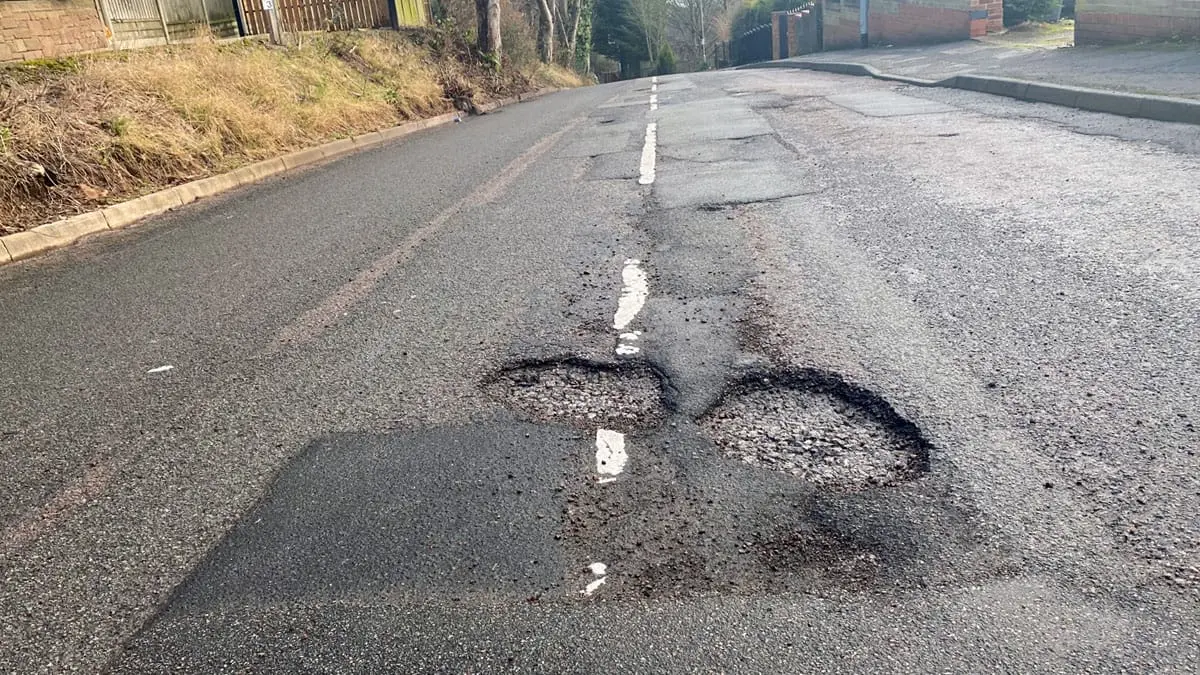
Gedling borough’s broken roads will start to see “substantial improvements” if the county council approves an extra £15 million to act on a county-wide highways repairs review.
But the authority’s transport committee chair also warned road users that change will not “happen overnight” despite plans to drastically reduce temporary pothole fixes and move towards permanent road re-patching schemes.
The council’s transport and environment committee met last week to discuss the authority’s long-planned highways review.
Conducted throughout 2021, it was launched to address what many councillors described as the “biggest issue on the doorstep” in last May’s council elections.
It involved a cross-party panel meeting over several months to discuss methods used by the council to repair roads in recent years and attempt to find new solutions.
Two external assessments of the authority’s current methods were conducted – one by consultants WSP and a second by the Local Government Association,
The assessments found the council should shift away from temporary repairs using a method known as Viafix and focus on permanent road replacement schemes whenever possible.
Viafix – a form of cold asphalt repair which fills in specific holes – would still be needed “protect the safety of road users” in the event of an emergency.
But the authority was told it should be using other forms of repair which replace whole stretches of road where possible.
Other recommendations included improving communications with residents on when their roads will be repaired, giving them “clarity”, and moving from a one-year to a three-year investment plan on where repairs will take place.
These recommendations will now be acted on said Cllr Neil Clarke (Con), the transport and environment committee chairman.
He confirmed an additional £15 million will be provided to the department over the next four years.
This will partly be funded by the authority increasing its standard council tax by one per cent from April.
Cllr Clarke says £12 million of this will be used to implement the review, with ‘patching gangs’ currently used to resurface roads due to double as the authority shifts to a “right repair, right first-time” approach.
Speaking in the meeting on Wednesday, Cllr Clarke said: “We are really emphasising and investing in our roads … to address the concerns in the review.
“At the moment there are four patching gangs and that £12 million will allow the doubling of those teams to present a major improvement in the way we address road repairs.
“In time there will be substantial improvements to see in our road repairs, it’s not all going to happen overnight but it will certainly have significant improvements with that additional investment.
“It won’t mean completely the end of pothole repairs because there’s always an emergency somewhere that needs to be repaired.
“But it will see a major reduction in those pothole repairs and a substantial increase in long-term road patching.”
The additional funding to invest in the review will go before full council as part of the wider budget on February 24.
Customers in Gedling borough will no longer be able to use first and second class stamps when a new barcode system is introduced next year.
Borough folk are now being urged to use their current stamps or swap them for the new ones before they expire on January 31, 2023.
Non-barcoded stamps can be exchanged for the barcoded version through Royal Mail’s ‘Swap Out’ scheme, which will open on March 31.
Forms will be available through the Royal Mail website and Customer Service Points, with customers able to use a Freepost address.
Royal Mail said: ‘Following a successful national trial we will now be adding unique barcodes to all our regular ‘everyday’ Definitive and Christmas stamps.
‘Each barcoded stamp will have a digital twin and the two will be connected by the Royal Mail App.
‘The unique barcodes will facilitate operational efficiencies, enable the introduction of added security features and pave the way for innovative services for our customers.
‘The new barcode is an integral part of the stamp and must remain intact for the stamp to be valid.’
Customers can scan the new stamp barcodes in the Royal Mail app and will eventually be able to watch videos, information about services, or even birthday messages and other greetings from senders.
At the moment, a video featuring Shaun the Sheep, created exclusively for Royal Mail by animation studio Aardman, can be viewed.
It is the first in a series of planned videos to be released during 2022 that will allow customers sending stamped mail to choose which one the recipient can see when they receive an item of mail.
Nick Landon, Royal Mail chief commercial officer, added: ‘Introducing unique barcodes on our postage stamps allows us to connect the physical letter with the digital world and opens up the possibilities for a range of new innovative services in future.’
An appeal to support a hospice in Mapperley through the festive season raised more than £17,000 in donations.
The Light up a Life appeal, which ran through November and December, encouraged people to donate in memory of a loved one and share a dedication on an online tree.
Supporters could also donate £350 – the cost of a night of care – to light up the hospice’s historic cupola tower for a night in a colour of their choice, to celebrate the life of someone special.
Family and friends of Ian Roper from Sutton in Ashfield chose to light the tower purple in his memory and as a thank you for his care.
Ian was referred to the hospice last July when his wife Kathleen began to struggle to look after him at home. Care from the hospice enabled Ian, who had arthritis, heart problems and prostate cancer, to be at home at the end of his life.
Ian’s daughter Liz said “Mum was really struggling. My sister and I helped as much as we could but when Mum was on her own, she was fearful. Initially she didn’t want to admit she needed help but when the hospice team came, she said they were wonderful.
PICTURED: Nottinghamshire Hospice lit up over Christmas
“The people who came were superb. They were lovely with my dad and skilled at making him comfortable. It was so reassuring for Mum. It gave her rest and meant she could sleep through the night.
“The hospice care was instrumental in allowing him to stay at home which was where he wanted to be. Having Dad home at the end of his life was the right thing to do. It helped the grieving process because we know we did our best to give him a peaceful end to his life”’
The family raised £1,500 through funeral donations and Kathleen, Liz and her sister Helen came to the hospice to see the tower lit.
They chose purple, his favourite colour.
Nottingham City Council also supported the appeal by lighting up the council house purple on one of the days.
Gemma Taylor Mahon, Fundraising and Marketing Manager at Nottinghamshire Hospice, said: “We’re so grateful everyone who supported our appeal.
Your donations will help us to continue to provide care to help families like Ian’s when they need us.”
Police are urging motorists to be vigilant in Calverton after a series of thefts and attempted thefts from vehicles in the village.
Incidents reported last weekend, and which remain under investigation, include bank cards stolen from cars and cash taken from vehicles which were left insecure.
In other instances entry was gained into unlocked cars but no valuables were taken.
Officers are investigating the incidents and enquiries also remain ongoing, including checking CCTV footage, after reports of a man seen trying car door handles in the area.
Sergeant Neil Langham, of Nottinghamshire Police, said: “We’re working hard to identify those responsible for these crimes. While our enquiries remain ongoing we’re also urging motorists to be vigilant and make it as difficult as possible for criminals to target their vehicles.
“Due to most modern cars having alarms, force is rarely used to enter vehicles and if the car is locked, offenders will just move on to the next one until they find one which is insecure.
“It’s also important people take steps to ensure their vehicles are as secure as possible as many insurance companies will not cover vehicles which have been left unlocked so there are additional risks in not securing them.
“We are urging people to make sure their vehicles are locked and they don’t leave any valuables on display.
“Find a secure place to park, such as in your garage if you have one, or alternatively ensure your vehicle is parked in a well-lit area.
“Having an alarm and immobiliser fitted to your vehicle is also an effective way of deterring criminals.
“We’re also urging local residents to be alert and report any suspicious people or vehicles to us.”
Anyone with concerns about car crime in their area can call police on 101. In an emergency or if an incident is in progress call 999. For more advice on how to protect your vehicle visit https://crowd.in/C1o8Ys
The local government watchdog has ruled Gedling Borough Council committed “no fault” when refusing a self-employed driving instructor’s applications for Covid-19 support grants.
A complaint was filed to the Local Government Ombudsman after the instructor, named in the complaint only as Mr M, was unsuccessful in applying for various grants from the council.
Local authorities were given the grants from central Government to administer to qualifying businesses, with several support packages on offer to help struggling companies cope with lockdowns.
Mr M applied for five separate grants to the council, all of which it refused.
However, his complaint related to an application for the Additional Restrictions Grant (ARG), which was refused due to a dispute over when he began trading.
The instructor was required to demonstrate he had been trading before October 1, 2020, to qualify for the grant, but the authority said he was not eligible since his instructor licence was issued on October 12.
Mr M contested this and said that, while he received his licence on this date, he began trading in the weeks “prior to this” having taken payment for lessons before the October 1 date.
Bank statements were provided but the council viewed this was “not classed as the business carrying out the activity for which it was set up”.
PICTURED: Civic Centre at Arnot Hill Park
Ultimately, after assessing Mr M’s complaint, the ombudsman viewed the council did not break any rules when refusing to give him the ARG payment.
A report published by the ombudsman states: “We can only consider whether the council has taken proper account of the evidence Mr M has submitted, and clearly explained the reasons for its decision.
“I am satisfied it has done so here, and the fact Mr M disagrees with the council’s view does not give me grounds to uphold his complaint.
“I do not consider it would be proportionate for the council to pay grants to people who did not qualify for them, simply for this reason.”
Mr M also complained about the length of time it took the authority to determine his application – more than two months when the advertised period was five days.
But the ombudsman viewed this as not a “significant matter” due to the additional information the council was asking for, and because the length of time did not have a sway on the authority’s decision.
However, the report goes on to address further issues raised by Mr M in his complaint which were upheld by the ombudsman.
It states Mr M was sent an email “in error” inviting him to apply for a different grant “on the basis he had been awarded ARG”.
At the point the email had been sent out, the council had not yet made a decision on whether to give Mr M the grant.
The council then sent an email apologising for the error, confirming his application was still pending determination.
The ombudsman concluded the authority was at fault for “wrongly telling the complainant his application had been successful”, stating however that the council’s apology was “adequate”.
The ombudsman report adds: “I am satisfied this error amounts to fault by the council, and I also accept Mr M was caused some distress by it.
“However, the council very quickly rectified its error and apologised for it, and I consider this is an adequate remedy.”
For this element, the ombudsman upheld the complaint finding “fault causing injustice”, but deemed the council has already remedied the issue.
The complaint will be reviewed by the authority’s cabinet when it meets on Thursday, February 17.
In a report, the council said: “Ultimately, the ombudsman determined there was no fault in how the council considered the complainant’s application for ARG, as it was entitled to decide the evidence did not support his eligibility.
“There was also no fault found in how the council decided his other grant applications.
“The ombudsman did conclude the council was at fault for wrongly telling the complainant his application had been successful, but concluded the council’s quick rectification and apology for this error was an adequate remedy.”
The Labour-led cabinet will decide next week whether any further action should be taken to address the complaint.
Gedling Borough Council has confirmed plans to increase its portion of council tax by £5 for residents living in Band D homes.
The Labour authority’s cabinet is recommended to approve the 2.89 per cent rise when it meets next week, with the increase equating to £3.33 more for people in Band A houses.
If approved, the rise would then be taken for debate at a full council meeting next month as part of wider budget plans.
Documents published ahead of the meeting on February 17 say: “With the continued removal of central government support, the council will increasingly rely on income generated by local fees and charges, and council tax.
“These will need to be consistently increased year on year to offset the momentum of continual reductions in available budgets.
“Covid-19 presents an additional risk to income levels, for which the recovery period is uncertain.”
It comes as other Nottinghamshire authorities outline their plans for council tax in the coming financial year.
PICTURED: Gedling Borough Council Civic Centre in Arnold
Conservative-led Nottinghamshire County Council – the authority that receives the highest proportion of residents’ bills – will increase its taking by four per cent from April.
For Band A homes this increase will mean annual bills rising by £42.16, with Band D properties to see a £64.24 rise.
Councillors on Broxtowe Borough Council have this week backed the authority’s own plans for a £5 Band D increase, with the council’s proposal to go before its full council meeting next month.
For Band A homes the increase would again equate to £3.33 per year.
Tory-led Rushcliffe has also moved a step closer to increasing its portion of the bill by 2.42 per cent – or £3.57 per year at Band D and £2.38 for Band A.
However, Mansfield District Council has already approved plans to freeze its precepts for the coming year after receiving what it described as “higher-than-expected” grants from the Government.
The Labour-led authority had initially planned a two per cent rise before receiving confirmation of its Government support in December.
And both Nottinghamshire Police and the Fire Authority have approved plans to increase their own precepts.
Caroline Henry (Con), the county’s police and crime commissioner, proposed a £9.99 rise for Band D properties, equating to £6.66 for Band A homes, which was approved by the Police and Crime panel earlier this week.
And the fire authority has approved a 1.95 per cent rise, which will see bills increase by £1.62 for Band D and £1.08 for Band A properties.
Ashfield, Newark and Sherwood, and Nottingham councils are yet to outline their council tax plans.
However, more than 330,000 households across Nottinghamshire will not feel the council tax increases after the Government announced a £150 rebate for people living in Bands A to D.
The rebate has been brought forward to help residents in tackling the ongoing ‘cost of living crisis’, with energy bills due to soar from April.
The support will not need to be paid back and will be deducted from residents’ bills by the collecting authorities, with the Government to pick up the bill to allow councils to increase their taxes and invest in services.
Gedling Borough Council has confirmed plans to increase its portion of council tax by £5 for residents living in Band D homes.
The Labour authority’s cabinet is recommended to approve the 2.89 per cent rise when it meets next week, with the increase equating to £3.33 more for people in Band A houses.
If approved, the rise would then be taken for debate at a full council meeting next month as part of wider budget plans.
Documents published ahead of the meeting on February 17 say: “With the continued removal of central government support, the council will increasingly rely on income generated by local fees and charges, and council tax.
“These will need to be consistently increased year on year to offset the momentum of continual reductions in available budgets.
“Covid-19 presents an additional risk to income levels, for which the recovery period is uncertain.”
It comes as other Nottinghamshire authorities outline their plans for council tax in the coming financial year.
Conservative-led Nottinghamshire County Council – the authority that receives the highest proportion of residents’ bills – will increase its taking by four per cent from April.
For Band A homes this increase will mean annual bills rising by £42.16, with Band D properties to see a £64.24 rise.
Councillors on Broxtowe Borough Council have this week backed the authority’s own plans for a £5 Band D increase, with the council’s proposal to go before its full council meeting next month.
For Band A homes the increase would again equate to £3.33 per year.
Tory-led Rushcliffe has also moved a step closer to increasing its portion of the bill by 2.42 per cent – or £3.57 per year at Band D and £2.38 for Band A.
However, Mansfield District Council has already approved plans to freeze its precepts for the coming year after receiving what it described as “higher-than-expected” grants from the Government.
The Labour-led authority had initially planned a two per cent rise before receiving confirmation of its Government support in December.
And both Nottinghamshire Police and the Fire Authority have approved plans to increase their own precepts.
Caroline Henry (Con), the county’s police and crime commissioner, proposed a £9.99 rise for Band D properties, equating to £6.66 for Band A homes, which was approved by the Police and Crime panel earlier this week.
And the fire authority has approved a 1.95 per cent rise, which will see bills increase by £1.62 for Band D and £1.08 for Band A properties.
Ashfield, Newark and Sherwood, and Nottingham councils are yet to outline their council tax plans.
However, more than 330,000 households across Nottinghamshire will not feel the council tax increases after the Government announced a £150 rebate for people living in Bands A to D.
The rebate has been brought forward to help residents in tackling the ongoing ‘cost of living crisis’, with energy bills due to soar from April.
The support will not need to be paid back and will be deducted from residents’ bills by the collecting authorities, with the Government to pick up the bill to allow councils to increase their taxes and invest in services.
A man who sexually assaulted a child has been jailed for six years.
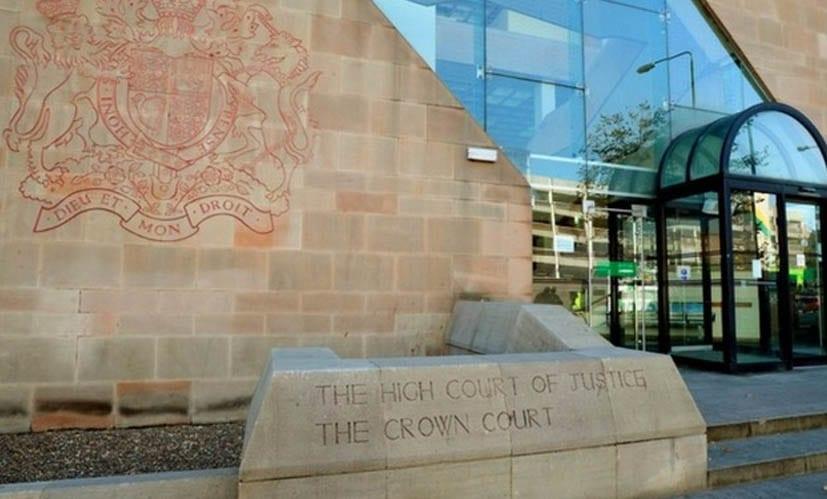
Ian Hudspeth, of Forester Street, Netherfield, was sentenced on February 10 at Nottingham Crown Court.
He was charged with five counts of indecent assault and four counts of assault, all on the same victim.
The incidents took place approximately 20 years ago in Nottingham when Ian Hudspeth was in his early 30s and began abusing the girl by touching her inappropriately.
The abuse stopped a year later – but the impact on the victim never went away.
In May 2019, the then 21-year-old revealed about her past abuse to her family and boyfriend.
The police were then informed, and Hudspeth attended a voluntary police interview.
He denied the allegations but was ultimately charged after the victim provided a detailed and consistent account of his crimes.
The matter was heading for trial until Hudspeth entered guilty pleas to all charges.
Following the sentencing, investigating officer PC Dave Randall said: “Hudspeth is a dangerous sexual predator and assaulted his victim when she was a defenceless child.
“The victim was very courageous to come forward and report what he had done.
“I am pleased we have managed to get justice for the victim and that Hudspeth will spend years behind bars.
“These were crimes he thought he would get away with, but he was wrong and will now face the consequences of his actions.
“I hope this sentence brings the victim closure and enables her to start moving on with her life.
“I also hope this result gives others confidence that Nottinghamshire Police will always be ready to listen to anyone who would like to report offences of this nature.
“We will support you every step of the way and ensure that we investigate thoroughly and leave no stone unturned to bring the perpetrator to justice.”
In addition to a six-year prison sentence, the 52-year-old man will be required to sign the sex offenders’ register for life.
A new Co-op store could be coming to Woodthorpe after a planning application was submitted to build the new convenience store.
The new store would be built on land formerly occupied by a haulage yard at the rear of Sunnyhome, Greendale Road.
A planning statement submitted with the application by applicants Coxmoor Developments says the development will comprise of a new single-storey building, expected to be occupied as a local convenience store together with storage.
It says the building would have a sales area of 255sqm which is below the threshold in the Sunday Trading Act, 1994, meaning that the store will be able to open without restriction, seven days a week.
The plans reveal that access to the retail store will be from Arno Vale Road to a car park which will be laid out to accommodate 13 customer parking spaces, including one disabled space and a parent/child space, with cycle parking and space for delivery vehicles to enter,
In their statement Coxmoor Developments said: “The store will function as a small, local food store helping meet the day-to-day needs of local residents, comprising a local walk-in catchment population and a limited amount of pass-by trade.
“The store is expected to carry a basic range of groceries, ready meals, sandwiches and snacks, beers, wines and spirits and a range of fresh fruit and vegetables.”
Dr Ian Campbell has been a GP in Carlton for 30 years. Here he has his say on the government’s recent Levelling Up white paper…
In my article published by Gedling Eye on January 26, I raised my concerns about the current “winter crisis” in the NHS but also set out my concerns for the future of NHS, and for our ability to address falling life expectancy and the worsening health inequity – the “health gap” – we are now seeing both here in Gedling and nationally. It was therefore, initially at least, great to receive the Government’s much anticipated Levelling-up White Paper, published earlier this month.
The socio-economic circumstances in which we are born, grow, live, and age have a profound impact on our health, and when we die. An example I gave within the Gedling borough area, cited the gap in life expectancy between the richest and poorest areas, meaning that, for example, a man in Netherfield can expect to die eight years earlier than a man in Burton Joyce, and have an even greater disparity of healthy-life expectancy, meaning he would also spend more of his life living with ill health.
This discrepancy in life expectancy is colossally unfair, immoral and, avoidable. The drivers of ill-health, what we call the “causes of the causes” or “social determinants of health” – housing, education and a fair living wage for example – are critical if we are to tackle this gross unfairness.
We desperately need, here in Gedling, access to greater funding to vastly improve community infrastructure, housing, transport and to strengthen our public services, in education, health and social services. And, of course, we need to stimulate our local economy to help provide sustainable, rewarding and fulfilling jobs, which pay a minimum income for healthy living.
Improving health and living standards for everyone, has profound socio-economic benefits for the whole of society, would take immense pressure of the NHS, and is both morally, and economically fair. We need to build back, but not just build back better, we need to Build Back Fairer.
It is now time to reverse course. The Levelling Up plan sets out in part what needs to be done and there is a lot to like within its’ more than 300 pages, citing plans to boost productivity, pay, jobs and living standards across society, to increase opportunity and improve public services, to restore a sense of community and local pride and empower local leaders and communities.
The White Paper also sets out 12 “missions” – to impact on living standards, transport, research, internet access, education, skills, health, well-being, pride in place, housing, crime and local leadership. If these “missions” were achieved I have no doubt health equity will improve too.
But here’s the problem…
This white paper has been prepared by a political party that has been in power in Britain for 30 of the last 43 years and was responsible for much of the damage it now wants to reverse. And since 2010 the austerity policies of the government have only accelerated that hardship. Public sector funding has fallen sharply, child poverty has risen, and there have been successive regressive cuts to tax and benefits. In 2020 almost 2 million children in the UK went hungry, prompting the United Nations agency UNICEF to develop a child feeding programme in the UK for the first time in its 70 year history! The Food Foundation reports that 1 in every 11 households, that’s 4.7 million adults, experienced food insecurity in the last month.
In the context of levelling up, the post-2010 cuts to local government, including here in Gedling, expose the harsh truth – the more deprived the area the steeper the cuts. Nationally, it has been estimated that cuts to local government in the North of England amounted to £413 per person. By contrast the 2021 allocation from the levelling up fund amounts to a poultry £32 for every man woman and child.
On the face of it, the Levelling Up objectives and missions are exactly what is needed. However, as the Chancellor of the Exchequer has made clear the regressive cuts to public expenditure will not be reversed and the government remains more interested in cutting taxes than levelling up.
What we are really witnessing is not a level of investment that will have a significant impact on social and health inequities; it is, instead, a woeful, shameful, drop in the ocean, and a token reaction to a, literally, life threatening crisis. As a doctor who cares passionately about the NHS, and someone who wants so much more for his community, I am bitterly disappointed that we can expect health inequalities to continue unabated. The Levelling Up white paper is a huge disappointment, and a huge opportunity wasted.
Have you got something to say about our borough? You can submit an opinion piece for consideration for publishing to news@gedlingeye.co.uk