


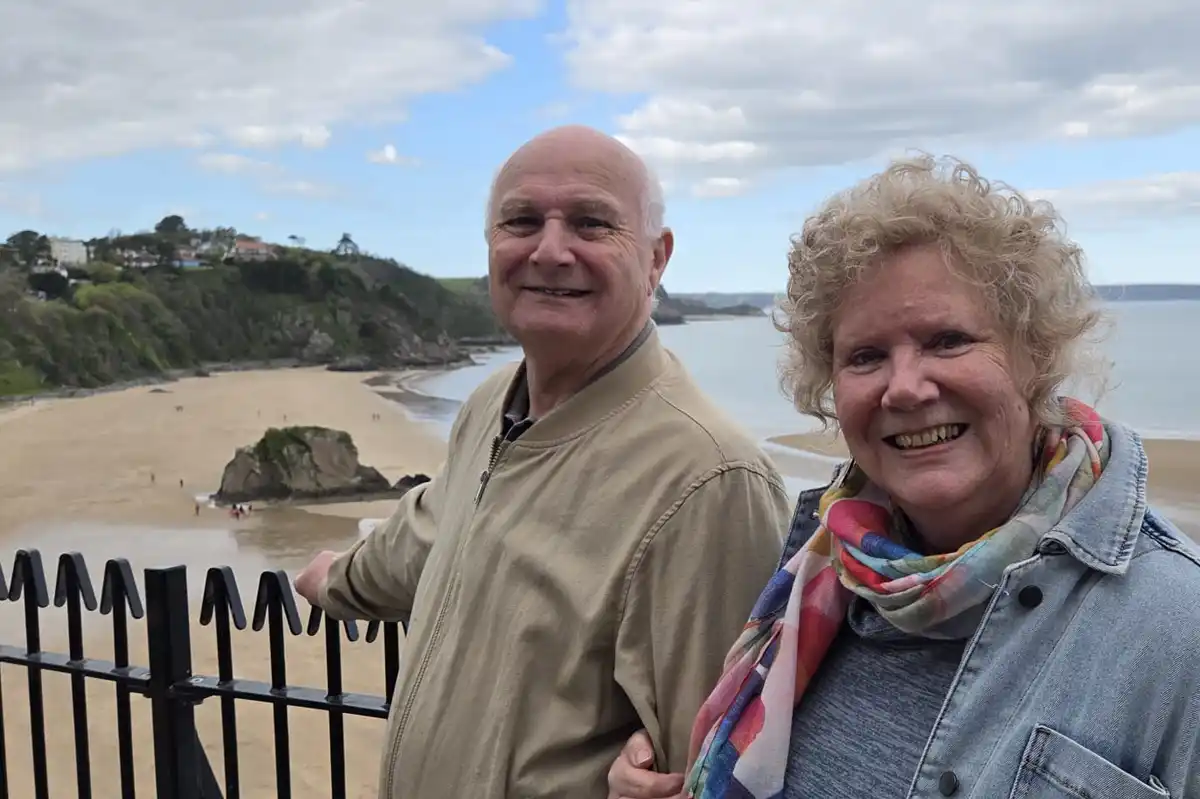

For Stroke Awareness Month, we’re sharing Terry’s story.
Terry suffered a stroke at the age of 73, which left him struggling with communication, balance and ongoing fatigue. However, with invaluable support from Nottinghamshire Healthcare’s Community Stroke team, he is now recovering well as his speech improves, and he regains his independence.
Terry was a Primary School Head Teacher who retired early due to a heart condition. He has been married to his wife, Terri, for 50 years.
He is a very active member of Mapperley and Arnold Rotary Club, organising charity events in the community and he leads a Memory café for those people living with dementia and their carers. He is also actively involved in Calverton U3A, running a social group for men.
At the time of Terry’s stroke, he experienced violent vomiting as he was going to bed and woke up early morning feeling confused and unstable.
“I passed off the vomiting as food poisoning as we had been out for lunch,” explained Terry.
“I then woke up at around 4am and again at 11am feeling very confused and unstable and difficulty in speaking. My wife realised I was having a stroke, as my face was also drooping slightly on the left-hand side. She phoned for an ambulance immediately having seen the FAST adverts on TV.
“While waiting for the ambulance, I felt frightened and emotional as I realised, I was having a stroke, and I knew what the consequences might be.”
The paramedics monitored Terry, and he was taken to the Queen’s Medical Centre (QMC) in Nottingham. After scans and being offered a clot buster injection he was taken to the Acute Stroke Care Unit.
“I was in QMC for four days where they discovered my carotid artery was 95% blocked and they confirmed a right hemispheric stroke,” said Terry.
“I was added to the waiting list for right carotid endarterectomy and bovine patch repair, a surgical technique to mend or strengthen, cardiac, vascular or soft tissue damage.
“The operation was done within two weeks of the stroke. I was in hospital for a further four days because my blood pressure was very low.”
Terry was then referred to the Trust’s Community Stroke team who provide specialist rehabilitation to people over 18 for the first 12 months following a stroke.
Tiffany Coulter, Speech and Language Therapist at the Trust said, “The stroke team supported him with reviewing and assessing his balance in and out of the home and with fatigue management.
“They also assessed any cognitive deficit post stroke as well as assessing and supporting his communication needs to access his activities of daily living and to enable him to return to all the positive things he contributes to in the community.”
Terry added “We are very impressed with the support we received from the stroke team. They explained what had happened to me, so I had a clear understanding of my situation. They gave me strategies for everyday living and how to move forward and encouraged me to set targets and were very encouraging when I achieved them.
“Tiffany accompanied me and supported me in my first major target which was to attend the Memory café and talk to the clients and carers.
“The team also encouraged me to start driving again as I had passed the cognitive tests and peripheral vision test for the DVLA. This was a huge step in achieving independence and improved my self-esteem.”
Although Terry is recovering well, the stroke has affected his day-to-day living, but this has not stopped him from leading an active life.
“I miss being able to communicate easily as I organise many events,” says Terry. “I particularly find it difficult to answer complex questions, especially over the ‘phone. I have to take things more slowly than I used to do in getting around as my balance was affected, but using a walking stick helps greatly. I suffer still from stoke fatigue which can be very frustrating, and I usually need a nap in the afternoon and go to bed much earlier than I used to. Since the stroke I have a loss of appetite and food tastes very bland to me.
“However, I am determined not to let the stroke stop me from leading an active life, I have just had to adapt a little bit. I watched my father battle to get back to fitness after his stroke when he was 60, and this inspired me to fight back and not give up. That is so important to me and my family.”
A stroke also has a profound impact on family members and Terry’s stroke brought anxieties to his wife and daughter.
“My wife and daughter have experienced tiredness, anxiety for my health and changes in routines. But they have also felt a sense of relief now they have seen the progress being made and the positive outcomes.”
Terry’s wife said, “We are proud of his determination and are glad to see a lot of the old Terry back again.”
Terry has achieved many of his short term aims and now wants to become more fluent in his speech, walk more and become less reliant on his walking stick for balance.
“I still need to improve my fine motor skills particularly on the laptop, which I still find frustrating,” says Terry. “My longer-term aims are to resume active leadership of the Memory Café and increase my participation in Rotary Club activities. I also am hoping to tackle the large wooden model which I received as a gift at Christmas, just before my stroke.
“We are also looking forward to planning more active holidays in the future and spending quality time with my grandchildren when circumstances allow.”
Terry’s story is a powerful reminder of the lasting impact a stroke can have and why raising awareness, recognising the signs, and supporting recovery is so important.
You can find more information about the Trust’s Community Stroke Teamor find out more about stroke and causes, symptoms, prevention, rehabilitation and support services at The Stroke Association or NHS website.