Home Blog Page 355

Traditional markets under threat: ‘The next generation does not want to come’

Standing amid racks of clothing on the Bulwell market stall he’s run for 44 years, Kevin Fitzpatrick delivers a simple and frank answer when asked how things are really going.

He simply thinks the market is ‘dead’.

“The next generation does not want to come on markets because it is just too much hard work now,” he says.

“We’ve been in a downward spiral. People used to follow family but there is no money in it.”

Regular markets selling typical, everyday goods date back hundreds of years, as far back as the Roman Empire and medieval Britain, with a particular boom when market towns were first chartered in the 11th Century.

Market towns bustled with activity for centuries before changing shopping habits and then the impact of high-speed internet connections changed retail forever in the early 21st century.

In Nottingham, the Victoria Centre’s indoor market opened in 1972 and was once home to more than 200 stalls. Now just 26 traders remain.

Those still there wait in limbo for a final decision from Nottingham City Council after it announced it was considering ending the lease 20 months ago, as it looks to save £39m over 50 years at a time when local authorities struggle with finances after a decade of austerity.

A similar fate is feared in Bulwell.

While the market place had a makeover in 2017, with £300,000 spent on regeneration works, it is far from the bustling markets of the 1980s.

“All these years ago a tenner would have been a day’s wages, but £100 now won’t cover wages,” Kevin says.

“Over the years, on the TV and the media, they put us down and used to say all we sold were counterfeit goods.

“If you go abroad, markets are bigged-up, but in the UK it is not.

“There used to be a few decent days here before Covid, but there is no future for markets now.

“The only ones which do well now are the specialist markets.”

The National Association of British Markets (NABMA) first tried to map out the state of markets across the country in 2005 with the commissioning of the Rhodes Survey, which led to extensive discussions in Parliament.

According to NABMA there were between 45,000 to 46,000 traders working markets as of 2009, with an estimated 95,000 people working in retail markets the same year.

Three surveys followed between 2014 and 2018, which revealed trader numbers had dropped to around 32,000 with people employed in the industry down to 57,000.

They highlighted an increasing number of traders going to niche market events, rather than standing at traditional markets, and more traders are now working on a part-time basis only.

NABMA says: “I is now safe to suggest that the number has declined further from the 32,000.”

Stall occupancy has also dropped to an average of 72 per cent, from 77 per cent in 2018, and relatively few markets actually monitor footfall which makes it more difficult to see how markets are really performing.

Mr Fitzpatrick argues the case for the return of a ‘Toby’, a traditional market manager who organises pitches and collects rent.

Now, he says, there are “too many faces running around” Bulwell market to manage it effectively and in a cost-effective way.

The benefits of a Toby in contemporary times have already been seen in Bingham, where the Thursday market has been “thriving”.

The small town of Bingham in Rushcliffe has a market charter and the council commissions Ophelia Marshall as its ‘Toby’ to manage it.

“There is a future in these markets, but what needs to happen is for them to have consistent market managers.” she says.

“I’m a traditional manager and that is an investment on behalf of the council.

“They take the rent, they manage the market, but they also manage the shoppers and so we get a clearer vision on what needs to happen for a market to be successful.

“Event markets are successful because they don’t happen every week. A successful weekly market needs a Toby.

“Every retailer and trader has something for under a fiver. Everyone, every demographic, can afford to take something home.

“Our market is beginning to get spotted, and highlighted for best practice. The biggest factor is that the council is supportive and agile, and Rushcliffe is adapting and supporting the traders, so they are paving the way.”

A Toby, however, requires investment.

The lack of available funds from local councils has furthered the demise of markets, with NABMA saying more than 80 per cent of traditional markets are now owned by local councils.

Many of these councils are cash-strapped, and balancing their budgets is becoming harder every year.

Several local authorities in Nottinghamshire have argued they have attempted to regenerate town centres, but they have been left to compete for money from the Government’s limited Levelling Up pot.

The city council’s portfolio holder for leisure and culture, Cllr Pavlos Kotsonis (Lab), says people’s shopping habits “were already changing” when the pandemic hit.

“It’s an issue that towns and cities across the world are grappling with, and impacts global brands and our high streets as well as traditional markets,” he says.

“The council has provided support to local markets, but of course there’s a limit to what we can do.

“In Bulwell we put a bid in for Levelling Up Funding for town improvements that would have benefited the market, but unfortunately the Government turned it down.

“At Victoria Market we have invested in the market and heavily subsidised its operation for many years. At all local markets we provided support to traders during the pandemic.

“Ultimately, though, it’s up to people whether they choose to shop at markets or not.”

A similar situation to in Bulwell’s is unfolding over in Gedling, despite investment and promises from the borough council.

Arnold’s market place was transformed from the 1960s, upon the demolition of the former British School which was built in the 1860s.

A flea market opened on the site of the old school after 1960, and in 2018 Gedling Borough Council took over the running of the market.

Traders have more recently been moved to Eagle Square, from their original town centre location after 50 years, while work was carried out on the £4m Arnold Market Place (AMP) development.

Arnold market is made up of stalls trading on Tuesdays, Fridays and
Saturdays, selling products including fruit and veg, fashion and books.

Meanwhile the new AMP development is home to a wine tasting experience, a pet accessory store, a cake shop and a delicatessen, as well as the relocated Post Office.

The council hopes the new offer will increase footfall in the town, ultimately benefiting the existing market, too.

While traders operating in Eagle Square say their new position has better footfall, trader numbers have plummeted from 110 to just five.

David and Mandy Rogers run a stall selling books and other items, and they fear investment has come too little, too late.

“I do not think markets as they are have a future,” Mr Rogers said.

“I am doing OK because we have our regulars.”

“It is a shame but what can you do about it?” Mrs Rogers added.

“I do not think the investment will make a difference. I don’t think the council is bothered, really.

“People are not coming because there aren’t a lot of stalls, but then new stalls only last around two weeks.”

Andrew Webb, who has operated a watch repair stall in Arnold for the past 40 years, echoed similar concerns.

“We will wait with bated breath to see if the investment changes anything,” he said.

“It is a dying trade. Whatever they do would not improve the market, because there is no new blood coming through.”

Leader of Gedling Borough Council, Cllr John Clarke (Lab), added: “Investing in our town centres to encourage growth and regeneration is a key priority for the council.

“Our town centre manager is working closely with local businesses and traders to find out what more we can do to help them and help increase footfall across our town centres.

“We applied to the government on two occasions for Levelling Up funding, which would have allowed us to invest significant amounts of money into improving our town centres, including market areas. Unfortunately, both applications were refused.

“We’ve consulted with market traders who made it clear that they want to stay at the current location at Eagle Square, Arnold, due to its prominent location.

“We will continue to support them here by using money from the UK Shared Prosperity fund to improve the market.

“Our investment in the AMP has seen five new start-up businesses open their doors and has helped revitalise that part of the town centre.”

Some attempt has been made to introduce young blood to the market scene across the country, including with a ‘Teenage Market’ in Kettering.

Some cities have invested heavily in indoor market buildings in the past, including Sheffield which opened its new £18m Moor Market in 2013.

Of its last markets performance report, published in 2022, NABMA says: “There is much to be learnt from the 2021/22 survey and issues raised that the markets industry needs to address going forward.

“While, for example, there is evidence of substantial future investment in new and redeveloped market buildings there are concerns, in particular, about trader numbers and financial viability for many markets.”

Council asks Gedling borough residents to report blocked drains and gullies needed for extra cleaning​

Nottinghamshire County Council is asking residents in Gedling borough to report blocked drains and gullies in their area as part of the Summer Gully Cleanse, a gully clearing works programme. 

Via East Midlands, Nottinghamshire County Council’s highways partner, will work alongside gully cleansing contractor, Flowline; to undertake gully cleansing works this summer, which is in addition to the council’s year-round maintenance programme on Nottinghamshire’s 185,000 highway gullies and drains.

While all gullies in the county are cleaned and their condition is logged on a regular cyclical basis, some blockages can occur between cleanses, so the council and Via are asking residents and road users to let them know about any problem sites in their local area.

These are the four types of gully blockage that should be reported.
A: Visible blockage in gully
B: Gully full to/above the top with debris
C: Standing water pooling around the gully while other areas are clear
D: Water visible in gully, but no debris
 

This information will be used to create a programme of additional gully cleanses through the summer months, as well as informing the wider gully cleansing programme.

Councillor Neil Clarke MBE, Cabinet Member for Transport and Environment at Nottinghamshire County Council said, “The drainage infrastructure on our roads and pavements in the county does an important job to keep our highways safe and reducing the risk of flooding.

“The Via East Midlands team do the vital work of ensuring that our drains and gullies are kept clean with all gullies being cleansed on a regular basis, but there are times where gullies may become blocked or are unable to cope with particularly heavy rainfall.

“We all need to play our part in helping to keep water draining correctly from our highway network and that’s why we’re asking residents and road users in the county to let us know about any areas of concern in their locality.

“These extra cleanses during the summer will enable us to focus on some of these sites, but we’ll also use the reports to help to inform our year-round programme.”

The council also reminds residents not to use highway drains to dispose of their waste. This includes cooking fat, paint, and other liquids, or other waste items which can block or contaminate the drains. Residents should recycle waste wherever possible, dispose of it in the bin, or take to a household waste site. 

As part of the Great Summer Gully Cleanse programme, residents are being asked to log details of blocked drains and gullies in their area, along with a photograph of the gully, by using a simple online form, which is available at www.viaem.co.uk/summer-gully-cleanse 

Carlton le Willows: Parents and carers invited to meeting with new trust

A Gedling secondary school which was rated as ‘inadequate’ by Ofsted earlier this year previously advised parents / carers of Carlton le Willows Academy students that the academy would be transferred to Delta Academies Trust.

Delta Academies Trust have now contacted Parents / Carers inviting them to attend a meeting for parents / carers at Carlton le Willows Academy on Wednesday June 14. The invitation is only extended to parents / carers of children in the school.

The invitation from Paul Tarn, CEO and Anna Rooney, Executive Principal dated June 7 stated:

“You may be aware that Delta Academies Trust has been named as the preferred sponsor for Carlton le Willows Academy. We are working together towards a date of 1 October 2023 for this transfer to take place. As part of this process, we would like to invite you to attend a meeting for parents. This will be held at Carlton le Willows Academy on Wednesday 14th June. There will be two identical presentations: one at 4.00pm and one at 5.30pm.

“We would welcome the opportunity to tell you about Delta Academies Trust, our vision for education and our commitment to support the students at Carlton le Willows. Our vision is to change lives and over the past six years, we have transformed education in our own academies, in schools joining the Trust, and in the schools of partners working with us.

“We would like to share our exciting plans for the future of the school, and we understand you will have questions you would like to ask. We also want to listen to your views and aspirations for your children, so that we can work together to make Carlton le Willows the outstanding school you and your child deserve.

“We do hope that you are able to attend and share your views.
PLEASE NOTE – this is a meeting for you as parents. It is important that you are given the opportunity to ask your own questions: in order that you have this opportunity, we are only inviting parents or carers of children in the school. If you are unable to attend, please rest assured that we will send the presentation home via email after the event.”

Parents / carers have been asked to confirm attendance via an online form to enable the management of seating and other arrangements.

Regular readers will be aware that Gedling Eye reported on February 22 that a Termination Warning Notice was issued to Carlton le Willows Academy on January 27, meaning the Government cash funding tap to the academy was at risk of being turned off by the Secretary of State.

At that time John Garibaldi, Chair of GNET wrote: “As has been reported, Carlton le Willows has now been issued with a Termination Warning Notice. This is usual after a negative Ofsted judgement and formally sets out the powers the Department for Education has to step in and withdraw funding if needed. However, no such withdrawal of funding takes place if the Department proceeds to transfer the Academy into a new trust.

“The DfE is now working to find a suitable sponsor for the Academy.

“Once identified (expected to be around the end of April), we at GNET will be tasked with finalising the transfer. This new trust will then provide enhanced support to ensure Carlton le Willows returns to being an excellent school at the earliest opportunity.

“In the meantime, trustees and governors are working together with Academy teachers to address the changes that need to be made following the Ofsted report.”

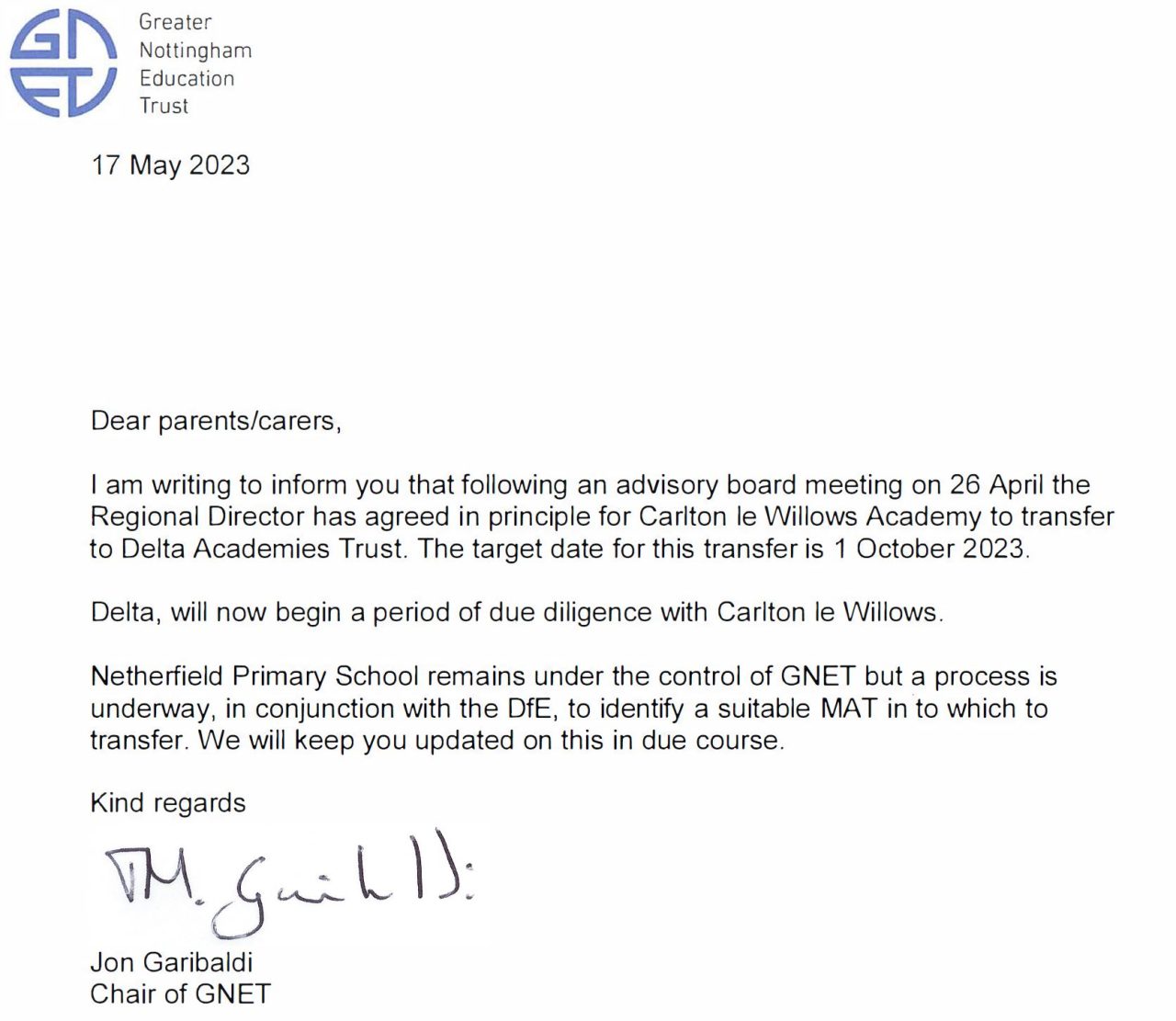
Then on May 17 John Garibaldi, Chair of GNET confirmed that the academy was proposed to be transferred to Delta Academies Trust.

Latest letter from the chair of GNET dated May 17

Today’s invitation from Delta Academies Trust confirms previous reports of the proposed transfer of the academy to Delta Academies Trust on October 1.

Delta Academies Trust is made up of 53 academies, including 34 primaries, 16 secondaries, 1 all-though and 2 alternative provision schools predominantly based around Yorkshire and the Humber.

Further information regarding Delta Academies Trust can be found HERE.

Wine and Gastronomy Escapes: City Breaks in France’s Culinary Capitals

France is renowned worldwide for its exceptional culinary delights and exquisite wines.

For food and wine enthusiasts, a city break in one of France’s culinary capitals is the perfect way to indulge in a gastronomic adventure. From savouring mouth-watering delicacies to exploring vineyards and wineries, these escapes offer an unparalleled experience. In this blog post, we will take you on a virtual journey through some of the best culinary destinations in France, where you can enjoy unforgettable wine and gastronomy experiences. Whether you’re planning the best cheap holidays to France or looking for a cheap city break in Paris, this guide has got you covered.

  1. Lyon: The Gastronomic Paradise

Known as the gastronomic capital of France, Lyon is a must-visit city for any food lover. Its rich culinary heritage and thriving food scene make it an ideal destination to explore French cuisine at its finest. With over 2,000 restaurants, Lyon offers a wide range of dining options to suit every taste and budget.

Head to Les Halles de Lyon Paul Bocuse, a famous indoor food market, to immerse yourself in a world of tantalizing aromas and flavours. Sample local specialities such as saucisson (dry-cured sausage), quenelles de brochet (pike dumplings), and praline tarts. Don’t forget to pair your meal with a glass of Côtes du Rhône or Beaujolais wine, both of which are produced in the region.

  1. Bordeaux: A Wine Lover’s Haven

When it comes to wine, Bordeaux is synonymous with excellence. This southwestern city is home to some of the world’s most prestigious vineyards and châteaux, making it a paradise for wine enthusiasts. With over 7,000 wine producers in the region, Bordeaux offers a remarkable selection of reds, whites, and rosés to satisfy every palate.

Embark on a wine-tasting tour along the famous Route des Vins (Wine Route) to discover the secrets of Bordeaux’s vineyards. Visit renowned estates like Château Margaux, Château Lafite Rothschild, and Château d’Yquem to witness the winemaking process firsthand and indulge in exquisite tastings. To enhance your wine experience, pair it with local delicacies such as canelés (small pastries) and entrecôte à la bordelaise (Bordeaux-style rib steak).

  1. Marseille: A Blend of Cultures and Flavors

Located on the Mediterranean coast, Marseille is a vibrant city bursting with diverse culinary influences. From traditional Provençal dishes to North African delicacies, the city’s melting pot of cultures creates a unique and exciting gastronomic experience.

Explore the bustling Vieux Port (Old Port) and its surrounding neighborhoods to discover local seafood delights. Feast on bouillabaisse, a traditional Marseille fish stew, or enjoy freshly shucked oysters paired with a crisp glass of Cassis white wine. For an authentic taste of the city, visit Le Panier, Marseille’s historic district, where you’ll find charming cafes and bistros serving regional specialities.

  1. Paris: A Culinary Wonderland

No discussion about French cuisine would be complete without mentioning Paris. While Paris is often associated with luxury dining, it’s also possible to have a cheap city break in Paris without compromising on culinary experiences.

Stroll through the vibrant Marché des Enfants Rouges, the oldest covered market in Paris, to discover a wide range of fresh produce, gourmet ingredients, and international street food. Indulge in delicious pastries from the local boulangeries, savour mouth-watering crêpes from street vendors, or enjoy a leisurely picnic along the Seine River with a baguette, cheese, and a bottle of wine.

  1. Nice: A Mediterranean Delight

Nestled on the French Riviera, Nice offers a delightful blend of Mediterranean flavors and Provençal cuisine. Known for its vibrant markets, picturesque streets, and stunning coastline, this city is a true paradise for food enthusiasts.

Start your culinary exploration at the Cours Saleya market, where you’ll find an array of fresh fruits, vegetables, and local specialities. Sample the famous Socca, a savoury pancake made from chickpea flour, or indulge in a plate of Niçoise salad, featuring fresh local ingredients like tuna, olives, and tomatoes. As you wander through the city, don’t miss the opportunity to try the exquisite Rosé wine from the nearby Provence region, perfectly complementing the Mediterranean flavours.

  1. Strasbourg: A Gastronomic Fusion

Situated in the Alsace region near the German border, Strasbourg offers a unique culinary experience influenced by both French and German traditions. This fusion of flavours creates a gastronomic tapestry that is truly remarkable.

When visiting Strasbourg, a visit to Petite France, the charming historic district, is a must. Here, you can indulge in traditional Alsatian dishes such as Choucroute garnie (sauerkraut with sausages and charcuterie) and Tarte flambée (a thin-crust pizza-like dish topped with cheese, onions, and bacon). To accompany your meal, try the local wines such as Riesling or Gewürztraminer, known for their aromatic profiles and exceptional quality.

Conclusion:

France’s culinary capitals offer an incredible blend of wine, gastronomy, and cultural experiences that will delight every food and wine lover. Whether you’re seeking the best cheap holidays to France or planning a cheap city break in Paris, these destinations will tantalize your taste buds and leave you with unforgettable memories. From Lyon’s gastronomic paradise to Bordeaux’s wine haven, Marseille’s cultural blend, and Paris’ culinary wonders, each city presents its unique charm and culinary delights. So pack your bags, embark on a culinary adventure, and let the flavours of France captivate your senses. Bon appétit!

Trio jailed over bungled cash-in-transit robbery in Woodthorpe

Bungling criminals have been locked up for their roles in a botched cash-in-transit robbery at a petrol station.

Gheorghita Ciucur and Marius Oana waited until a security delivery driver returned to his van and then tried to wrestle the cash box from him.

The tug of war continued but the driver wouldn’t let go and the pair ran off emptyhanded after a woman shouted at them.

The bungling robbers had been driven to the BP petrol station, in Mansfield Road, Woodthorpe, by 25-year-old Gymi Virtan.

The failed heist happened at around 2.40pm on Friday 4 November 2022.

Ciucur, aged 35, and Oana, aged 27, fled the scene in the same car which was identified and later stopped by police on the A50 in Staffordshire.

The three occupants were arrested and items including face masks, gloves, an angle grinder and sledge hammer were found in the boot.

Ciucur, Oana, and Virtan were subsequently charged and pleaded guilty to attempted robbery.

They appeared at Nottingham Crown Court for sentencing on Monday (5 June 2023).

Ciucur, formerly of Cole Hall Lane, Birmingham, was jailed for three-and-a-half years.

Oana and Virtan, both formerly of Shenstone Road, Soho, Birmingham, were locked up for three years.

Virtan also pleaded guilty to driving without insurance. He was banned from driving for 30 months.

Inspector Steve Dalby, of Nottinghamshire Police, said: “This was a planned and brazen attack on a security driver in broad daylight.

“The offenders travelled a substantial distance from the West Midlands knowing exactly when their target would be in the location for this offence to be committed.

“I hope the sentences passed to Oana, Ciucur and Virtan will deter other would-be offenders and sends out a clear message that Nottinghamshire Police will deal robustly with those involved in serious crime of this nature and will do all it can to bring them to justice.”

Gedling’s new Mayor attends Play Forum open day

Councillor Julie Najuk, Gedling borough’s new mayor was among the visitors to an open day at Gedling Play Forum on Wollaton Avenue this week (May 29).

Mayor Najuk got to enjoy the environmental projects on offer including making “seed bombs” to provide British wild flowers, biodegradable plant pots, and “bee feeders” to encourage pollinators.

The Mayor followed this by visiting the ‘Scrap Store’ which stocks a wide range of recycled materials, most of the materials were originally destined for landfill but have been donated by companies for creative play.

Then it was on to the the ‘Craft Shop’ which stocks a range of craft and creative materials including paint, glue, clay, card, die cut shapes, pipe cleaners, trimmings and much more.

Anne Crosbie the Forum’s co-ordinator said:

“It’s been a busy weekend for the Play Forum. On Saturday we were at the Calverton Methodist Church Spring Fair, and today we opened up our centre for visitors”.”

As well as the volunteers who help run the Forum, the team were joined by three volunteers from John Lewis as part of the John Lewis community volunteering programme.

Anne Crosbie added “We are really pleased to work with John Lewis and to gain from the experience and expertise of their partners and we know that they enjoyed it too”.

Gedling Play Forum was founded in 1987 to support children’s play within Gedling Borough and supports children’s play, family activities, learning, environmental projects, and community cohesion.

The Resources Centre provides services ranging from providing a scrap store to community play activities, from volunteering activities to workshops.

The play forum are always on the look out for clean non-toxic materials to use for creative play. If you know of a company that could help supply their scrap store then please contact them. Types of materials most needed include: new paper and card, fabrics, plastic mouldings, clean food trays, wool, end of lines and anything weird and wonderful that we can offer for creative play. Please contact the Play Forum if you are not sure. They are happy with a bag full or pallets and share any excess with other scrap stores.

Gedling Play forum can be found at Wollaton Avenue Community Centre,
Gedling, Nottingham, NG4 4HX.

Opening Hours
Monday : Closed
Tuesday : 10:00am – 4:00pm
Wednesday : 10:00am – 4:00pm
Thursday : 1:00pm – 5:30pm
Friday : Closed
Saturday : 1st Saturday of the Month 9:00am – 12:00noon

Further information including contact details can be found via their website Gedling Play Forum

PLANNING: Popeyes submit their plans for their new drive-thru at Teal Park near Netherfield

Planning application documents have been submitted to Gedling Borough Council (GBC) for the erection of a drive thru restaurant, with associated access, car parking, drainage and landscaping at Teal Park.

The application by Pegasus Planning Group on behalf of A C Lloyd Holdings Limited of Warwick relates to the construction of a Popeyes Fast Food Restaurant with Drive Thru.

The Teal Park site is located near Netherfield with access via the A612 – Colwick Loop Road.

The design and access statement supplied to GBC from Stephen George & Partners LLP (SGP) advises that vehicular access to the restaurant will be from the new shared access road from Magenta Way into the local centre.

Pictured: Proposed location of new Popeyes restaurant. Courtesy of Gedling Borough Council Planning

The car park will be located to the front of the restaurant with the entrance clearly identified by signage. The proposal includes 35 parking spaces that includes staff, customer, collect, waiting and accessible parking.

Pictured: Proposed site layout of new Popeyes restaurant. Courtesy of Gedling Borough Council Planning

The accompanying planning statement by the Pegasus Group advises that the proposed drive thru is located within the western part of the site, with car parking located in the eastern part of the site and a drive thru lane is proposed around the building.

Pictured: Proposed elevation views. Courtesy of Gedling Borough Council Planning

The proposed building is single storey in height, approximately 6.8m in height to the highest point of the development and proposes an internal area of 253 square metres.

There will be a cycle storage area for up to four cycles.

The planning application indicates that there is an expectancy to create 30 full time equivalent jobs.

Full details for planning application 2023/0435 are available HERE

Top 5 famous foods in Europe you must try

Welcome, food enthusiasts, to the delightful world of European gastronomy! A journey through the rich and diverse culinary traditions of Europe promises an enchanting experience for your taste buds. Today, I invite you to explore five famous must-try foods during your culinary adventure. So, grab your napkin, and let’s embark on a delectable journey across Europe!

  1. Escargots

If you’re going with any of the France tour packages, you’ll obviously visit the capital city, and that’s precisely where you need to be! In the romantic city of Paris, one dish that cannot be missed is the famous Escargots. 

These succulent snails, cooked to perfection, are often prepared with garlic, parsley, and butter, creating a symphony of flavors that will leave you craving for more. The snails are delicately nestled in their shells, providing a unique experience as you savor each bite. Be sure to pair this delightful dish with a glass of fine French wine for an extraordinary culinary experience!

  1. Belgian Waffles

Now, after trying out French delicacies, let’s take the Paris to Brussels train and continue exploring! As we move on to Brussels, prepare yourself for a taste sensation that will have you dreaming of Belgian waffles long after you’ve left the city. 

These delectable treats are known for their crisp exterior and fluffy interior, topped with a generous dollop of whipped cream and fresh fruits. Whether enjoyed as a breakfast delight or a sweet afternoon snack, the Belgian waffles in Brussels are a delightful indulgence that will satisfy your cravings for something sweet.

  1. Stroopwafels

In the charming city of Amsterdam, be sure to sample the delicious Stroopwafels. These sweet treats consist of two thin waffle layers sandwiched together with a rich, caramel-like syrup filling. Freshly made and served warm, the Stroopwafels offer a delightful contrast of textures and flavors, making them an irresistible snack to enjoy while strolling along the picturesque canals of Amsterdam.

  1. Croque Monsieur

Let’s move back to France once more via the Amsterdam to Paris train! Upon returning to Paris, you must indulge in another French culinary classic, the Croque Monsieur!

This grilled ham and cheese sandwich is elevated to new heights with the addition of creamy béchamel sauce and a generous sprinkle of grated Gruyère cheese. The combination of flavors and textures in this comforting dish will transport you to a Parisian bistro, leaving you with a contented smile and a satisfied stomach.

  1. Carbonara

Our culinary adventure concludes in the eternal city of Rome, where you simply must try the iconic Carbonara pasta. This Roman specialty features perfectly cooked pasta tossed in a velvety sauce made from eggs, pecorino cheese, and crispy pancetta. Each bite is a harmonious blend of rich, creamy flavors that will leave you enchanted by the simplicity and elegance of Italian cuisine.

Did you know that the origins of Carbonara are surrounded by speculation and folklore? While there is no definitive story, one theory suggests that Carbonara was created by Italian charcoal workers (carbone means charcoal in Italian) who used the few ingredients they had available, such as eggs, cheese, and cured pork, to create a hearty and satisfying meal!

As we bid farewell to this journey through the culinary wonders of Europe, we hope you’ve enjoyed these five famous foods that represent the diverse flavours and cultures of the continent. From the Escargots of Paris to the Carbonara of Rome, each dish tells a story of tradition, creativity, and the passion for European gastronomy. So, pack your appetite and embark on your own gastronomic adventure through Europe – bon appétit!

From Cars To Fruit: How supply chain issues still cripple UK businesses

In recent times, the UK has been facing a significant and highly disruptive supply chain crisis. Several interlinked factors have culminated in what appears to be a perfect storm, severely impacting businesses across sectors and leading to widespread shortages. Let’s delve into the root causes and the potential remedies for this challenge.

A Confluence of Disruptions

The UK’s supply chain issues stem from a combination of the COVID-19 pandemic, Brexit-related changes, and a nationwide shortage of Heavy Goods Vehicle (HGV) drivers. The pandemic caused severe disruptions to global supply chains, resulting in increased demand and a sharp decline in the supply of various goods. Brexit, on the other hand, has led to an exodus of European workers from the UK, further exacerbating labour shortages across many industries, including logistics and transportation. That, in turn, is leading to unprecedented pressures across the supply chain. Brands are having to lean on reseller incentives and new connections to secure their supply chain.

The Driver Deficit

The HGV driver shortage was perhaps the most visible aspect of the crisis. The Road Haulage Association estimates that the UK was short of approximately 100,000 HGV drivers in 2021 – now that figure stands somewhere close to 60,000, which is still a number high enough to cause disruption and delays. The lack of drivers has disrupted the delivery of goods, leading to empty shelves in supermarkets and delays in other sectors, including construction and hospitality. Several factors have led to this shortage, including an ageing driver population, poor working conditions, the impact of IR35 tax changes on self-employed drivers, and a backlog in driver testing due to the pandemic.

Brexit and New Barriers

Brexit has introduced new customs procedures and paperwork for goods crossing the UK-EU border. Many companies were unprepared for these changes, leading to delays, increased costs, and disruptions. Brexit has also made the UK a less attractive place to work for many European citizens, contributing to labour shortages across various sectors, including agriculture, hospitality, and logistics.

Pandemic-Powered Problems

The COVID-19 pandemic has further complicated matters. Global lockdowns and subsequent reopening have led to a boom in demand for goods, putting pressure on already stretched supply chains. Also, localised outbreaks of COVID-19 in factories and distribution centres have caused temporary shutdowns, disrupting the production and distribution of goods.

Solutions and Mitigations

Addressing the UK’s supply chain crisis requires a multi-faceted approach. Increasing wages and improving working conditions could make jobs in sectors like transportation and agriculture more appealing. Investing in training and apprenticeship programs could help fill the driver shortage in the long term. In the short term, temporary visas for foreign drivers and workers in other shortage-hit sectors could alleviate the immediate pressure.

Businesses can also take steps to make their supply chains more resilient. Diversifying suppliers, increasing stockpiles of key goods, and investing in supply chain visibility technology can help companies better anticipate and manage disruptions.

The UK’s supply chain crisis is a complex problem with no easy solutions. It will likely take a combination of government action, industry initiatives, and business adaptations to overcome these challenges. As the UK navigates this difficult period, the lessons learned could serve to strengthen the resilience of supply chains and the overall economy in the long run.

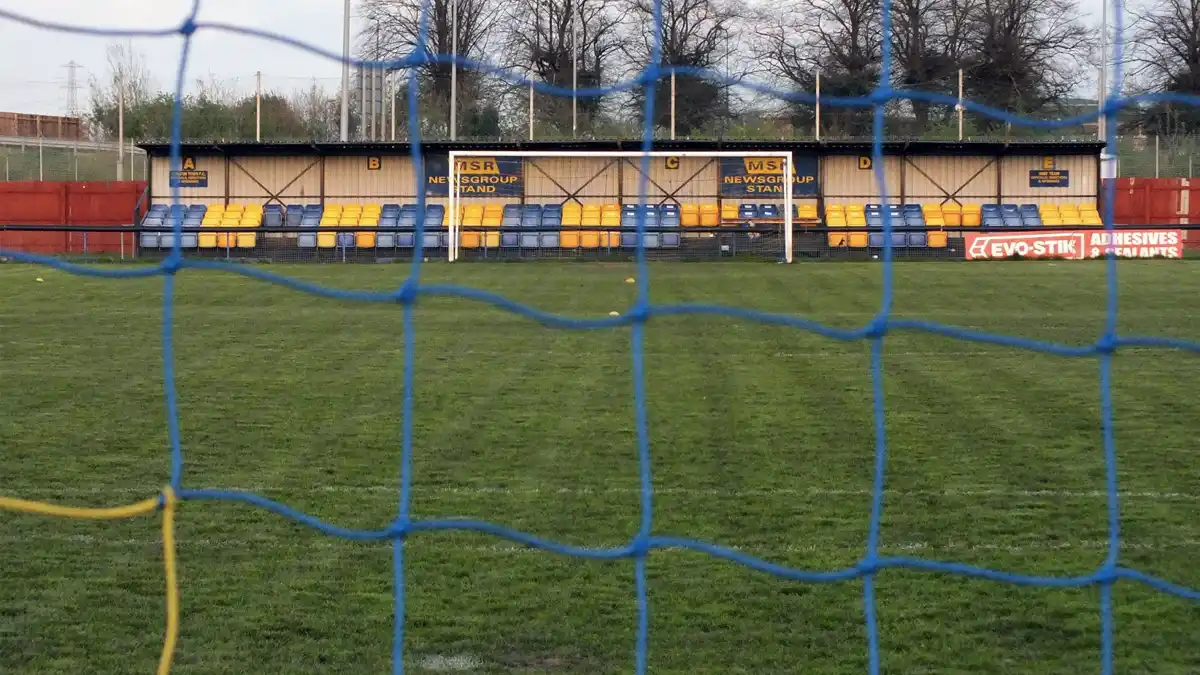
Carlton Town supporters help keep the lights on at Stoke Lane as fundraising tops £6k

Fundraising to help a local football club rocked by a shockingly high electric bill has hit the £6,000 mark.

Carlton Town revealed last month that after submitting a meter reading, they received a bill for a whopping £8714.03 (including VAT).

A fundraising campaign was then launched to help find the funds to pay off the debt, with owners and fans all reaching into their pockets.

The club have now confirmed on their website that fundraising has passed the £6,000 mark.

Mick Garton and Barry North started the fund with £1,000 each closely followed by Gilbert Wealth £500 and Russell Scanlan £500.

This was followed by the club raising £500 on a football number card, an anonymous donation of £250 and another donation of £250 from Simon Rood.

Lynms the funeral directors have contributed £300 as well as a £500 donation from a branch of the Nottingham Forest Supporters Club.

Kelly Mitchell also set up a Go fund me page which has now raised £840 of the £1,000 target and donations can be made here

Next up in the fund raising campaign is a quiz night at the William Gunn on June 5 and another football card.

The club have also stated that there have been a couple of smaller but valuable donations at the ground and the club has thanked everyone for their support saying “It really is much appreciated by the club!”

Commercial Chief Gary Clarke can be contacted on 07907 064189

The latest statement and news can be read on the Millers website HERE